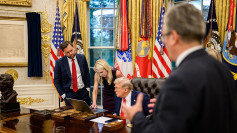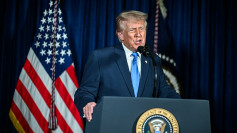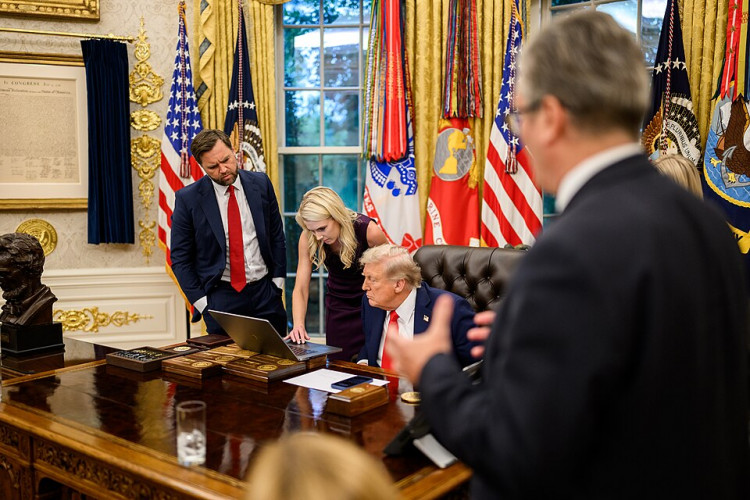
President Donald Trump's decision to ban CNN, MS NOW and Politico from the White House came hours after aide Natalie Harp showed him clips of critical MS NOW coverage, according to reporting about the events preceding one of the administration's most significant confrontations with the press. The timing provides new context for the Sept. 18 directive but doesn't establish that Harp recommended or prompted the ban.
The Daily Beast, citing reporting by The Wall Street Journal, said Harp showed Trump the MS NOW segments before he announced the restrictions on Truth Social. Trump subsequently accused the three organizations of repeatedly publishing false information and said their access would be revoked immediately.
"I am proud to announce that, effective immediately, I am banning Fake News CNN, MSNOW ... and Politico ... from the White House as a result of their constant 'reporting' FAKE NEWS!" Trump wrote. He warned that additional organizations could face similar action.
"Media Outlets shouldn't be able to constantly write or report FICTION and LIES when they're covering the President of the United States, the Trump Administration, or the United States of America," Trump added. "Other Fake News Media Outlets to follow."
Trump publicly characterized the decision as the result of longstanding dissatisfaction rather than identifying a single broadcast or article as the catalyst. Asked in the Oval Office what had prompted the action, he said, "It's really just cumulative stories over the past few years," Reuters reported.
Asked which organizations could be next, Trump named The New York Times and The Washington Post. His comments identified them as potential targets but didn't amount to an announcement that either publication had lost White House access.
The reported involvement of Harp adds another element to the sequence. A longtime Trump aide known for closely monitoring media coverage, Harp has remained part of the president's information operation in his second administration. The available reporting says she showed Trump the critical television clips; it doesn't establish that she proposed revoking credentials or participated in making that decision.
The directive also appeared to catch some administration officials off guard. Politico, citing three people familiar with West Wing conversations, reported that some senior White House staff learned about the ban from Trump's social-media announcement. Chief of Staff Susie Wiles was out of town when Trump issued the directive, according to the report.
Reporters from the affected organizations were still inside the White House on Friday after Trump posted his announcement. By Saturday morning, however, journalists from CNN, MS NOW and Politico encountered disabled credentials or were turned away by security personnel.
MS NOW reporter Akayla Gardner said she passed through the first two White House entrance gates before attempting to scan her badge near the security checkpoint. The scanner flashed red, she said, and an officer subsequently told her the credential had been disabled and asked her to surrender it.
Gardner said an MS NOW photographer also lost access, while a producer working for the network was admitted after that person's credential continued to function. Security officers appeared uncertain about the discrepancy when Gardner asked why members of the same organization were being treated differently.
CNN reporter Betsy Klein separately said her White House credential had been deactivated. Politico reporter Cheyenne Haslett was turned away and had her badge confiscated, according to the Associated Press.
The dispute escalated Monday when CNN, MS NOW and Politico announced plans to sue the Trump administration. The organizations said they had notified the government that they were seeking to restore access and challenge what they described as retaliation for their journalism.
"Without notice or process, the White House revoked our journalists' credentials because it objected to our reporting," the organizations said in a joint statement. "Left unchallenged, this threatens press freedom and the public's right to independent journalism free from government interference."
The outlets said they were acting to protect "our First Amendment rights and defend the principle that the government does not decide what the press reports or publishes." Their lawsuit adds a constitutional challenge to a dispute that had initially centered on physical access to the White House complex.
White House Correspondents' Association President Jacqui Heinrich also called for the journalists' credentials to be restored. "When the government retaliates against news organizations because it dislikes their coverage, it sets a dangerous precedent that could be used against any outlet in the future," Heinrich said in a statement reported by the Associated Press.
The fight has also disrupted the television pool system used to cover presidential events when space is limited. After the White House prevented CNN from fulfilling its scheduled role as television pooler, the other major networks declined to substitute for it, leaving some presidential events without the customary pooled television camera.