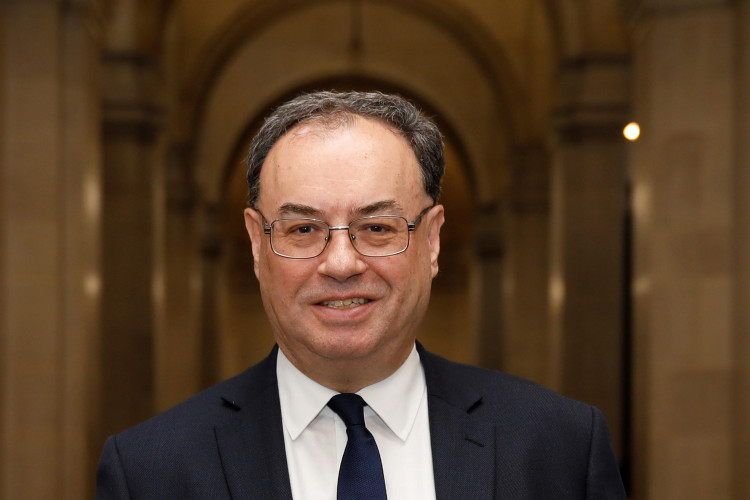
The Bank of England said it would not print money to finance an increase in government spending and bailouts as it seeks to protect Britain's economy from the ongoing global health crisis, bank governor Andrew Bailey disclosed late Sunday.
The central bank stepped up its equity acquisition plan last month by a whopping 200 billion pounds ($245.2 billion), close to actions by the US Federal Reserve and the European Central Bank as key finance institutions struggled across the globe to curb a crippling recession.
Finance Minister Rishi Sunak declared the next day that the British state will shoulder 80 percent of the regular wages of employees temporarily furloughed by businesses, aiming to bring them back to work as soon as the crisis ends.
As the United Kingdom ramps up borrowing significantly to fund the pandemic's economic impact, that prompted some commentators to warn that there is a risk if the bank will directly finance government spending and potentially unleash a wave of runaway inflation.
Bailey dismissed the argument in an op-ed published Sunday in the Financial Times, saying "the institutional protections of the United Kingdom rule this strategy out."
Using monetary financing would ruin the reputation and erode operational independence in managing inflation, he said. The financing, Bailey added, would eventually lead to an unsustainable balance sheet inconsistent with an independent central bank's pursuit of an inflation target.
Bailey had a baptism of fire at the BOE, was forced to slash interest rates to 0.1 percent and restart quantitative easing on March 16 within days of becoming governor. That was the second of two emergency actions taken last month by policy-makers.
Although monetary financing is controversial, some sectors say that it might be appropriate in the current market turmoil. One advocate is former Bank of England Deputy Governor Charles Bean, who said the BOE bank must acquire bonds directly from the government last week, provided the holdings were unwound promptly after the crisis over.
When the BOE announced on March 19 the expansion of its bond buying program to 645 billion pounds - mainly for government loans - Bailey emphasized that he was not ignoring central bankers long-standing fears about monetary finance because "history shows us where that leads."
The possibility of central banks helping governments spend more has sparked fears about potential inflation rises. This has also drawn comparisons to the catastrophic hyperinflation in Germany in the 1930s and Zimbabwe in the 1990s.