(Photo: NASA/JPL-Caltech/University of Arizona)
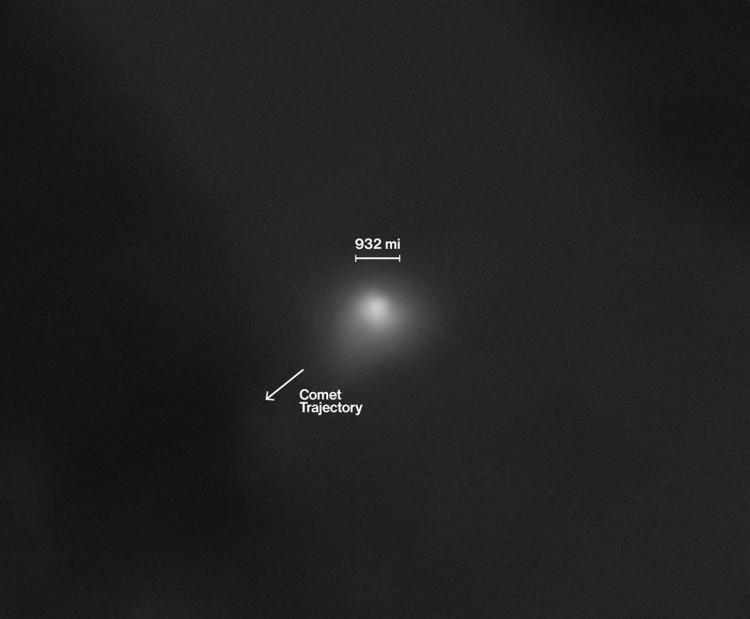
A rare combination of astronomical events is capturing attention across the scientific community and among skywatchers this month as NASA tracks the interstellar visitor Comet 3I/ATLAS during its December passage near Earth. The object, only the third confirmed interstellar body ever observed, will reach its closest approach on Dec. 19 at a distance of roughly 170 million miles-about 700 times farther from Earth than the Moon-while two other major celestial displays, the Geminid meteor shower and a conjunction of Jupiter and the Moon, unfold throughout the month.
NASA's December observing guide underscores the unusual convergence of a high-speed interstellar comet, one of the brightest annual meteor showers, and a planetary-lunar alignment, offering a rare opportunity for researchers to coordinate global observations. Comet 3I/ATLAS, discovered July 1, 2025, by the ATLAS survey telescope in Chile, follows a hyperbolic trajectory and is traveling too fast to remain gravitationally bound to the Sun. Its passage provides a brief window for astronomers to examine material originating from beyond the solar system.
The comet reached perihelion on Oct. 29, passing just inside Mars's orbit before turning outward. Hubble estimates place its nucleus between 440 meters and 5.6 kilometers in diameter, though the coma and surrounding dust make precise measurement difficult. NASA and international observatories are coordinating ground-based and spacecraft observations aimed at analyzing the comet's composition, dust production, and trajectory as it moves through the inner solar system.
Despite its scientific value, 3I/ATLAS will remain a challenge for amateur observers. Even at closest approach, the comet will require at least a 30-centimeter aperture telescope to detect. NASA instructs skywatchers to search the east-northeast pre-dawn sky, locating the region just below Regulus in the constellation Leo.
The Geminid meteor shower, by contrast, will be visible to the naked eye. Expected to peak on Dec. 13-14, the Geminids could produce up to 120 meteors per hour in dark conditions. Unlike typical meteor showers that originate from cometary debris, the Geminids are generated by 3200 Phaethon, a rocky Apollo-class asteroid. The composition of its debris field-larger, denser particles-explains the shower's frequent bright "fireball" meteors and slower apparent speeds.
Jupiter will serve as a useful orientation reference for Geminid viewing, rising brightly in the eastern sky near the shower's radiant in Gemini. NASA notes that the combination of peak activity, favorable evening timing and minimal equipment requirements makes the Geminids the most widely accessible of December's sky events.
Earlier in the month, on Dec. 7, Jupiter and the Moon appear in conjunction, forming a prominent pairing visible shortly after sunset. The optical illusion of proximity-despite being separated by hundreds of millions of miles-creates one of the simplest astronomical displays to observe. Jupiter will shine at an apparent magnitude near -2.8, positioned just above and slightly right of the Moon.