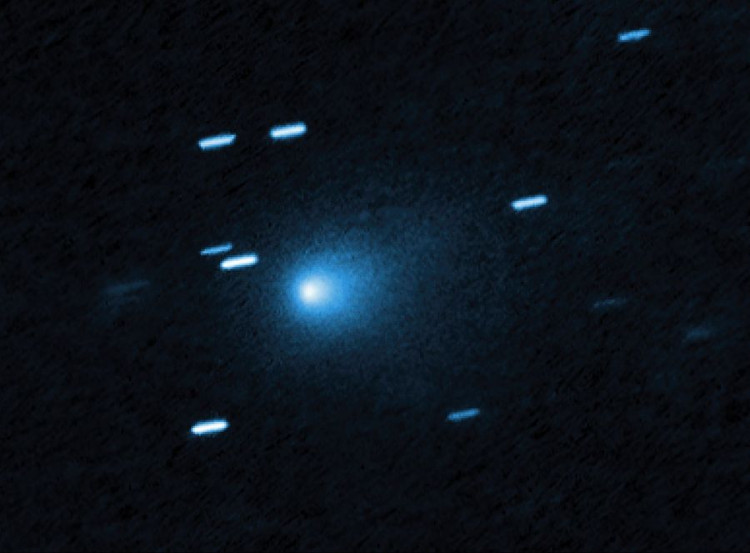
(Photo: NASA, ESA, David Jewitt (UCLA); Image Processing: Joseph DePasquale (STScI))
Astronomers tracking 3I/ATLAS, the third confirmed interstellar object ever observed, say new measurements of its water loss and chemical makeup are offering one of the clearest looks yet at material formed around another star, even as searches for artificial signals from the object come up empty.
The object was first detected on July 1, 2025, by the ATLAS system in Chile, entering the inner solar system at roughly 61 kilometers per second. Its hyperbolic trajectory and orbital eccentricity of about 6 confirm it is not gravitationally bound to the Sun and will never return.
New observations from the SOHO spacecraft, using its SWAN instrument, have allowed researchers to track hydrogen emissions created when solar radiation splits water molecules released by the comet. The results, described in a preprint submitted to The Astrophysical Journal Letters, show water production rates far exceeding those of most comets native to the solar system.
Around its perihelion on Oct. 29, 2025, at a distance of 1.36 astronomical units, 3I/ATLAS reached a peak water loss rate of roughly 3.17×10²⁹ molecules per second. By early December, that rate had fallen by more than an order of magnitude, to about 1-2×10²⁸ molecules per second.
Researchers estimate that in the month following perihelion, the object released more than 13.5 million metric tons of water into space. The scale of that loss suggests a large nucleus-potentially approaching 20 kilometers in diameter-with an active surface fraction estimated near 8%, unusually high for an object at that distance.
The rapid decline in activity is drawing particular interest because it allows scientists to compare the volatile behavior of an interstellar object with that of comets from the solar system's Oort Cloud. Early spectral data also point to an unusual abundance of atomic nickel, distinguishing 3I/ATLAS from the earlier interstellar visitor 2I/Borisov.
As the object passed its closest point to Earth on Dec. 19, 2025, at about 1.8 astronomical units, astronomers also completed a coordinated search for possible technosignatures. The effort was led by the Breakthrough Listen program using the Green Bank Telescope.
According to lead author Ben Jacobson-Bell, the initial data processing flagged hundreds of thousands of candidate signals, but all were traced to terrestrial interference. "We find no credible detections of narrowband radio technosignatures originating from 3I/ATLAS," Jacobson-Bell wrote, adding that the search ruled out any artificial transmitter stronger than 0.1 watts at the object's location.
While speculation about alien probes briefly surrounded the comet, the absence of detectable signals has refocused attention on its scientific value as a natural sample from another planetary system. Observers cited by BBC Sky at Night Magazine note that the object has faded to around magnitude +15.6, placing it beyond naked-eye visibility and limiting observations to large telescopes.