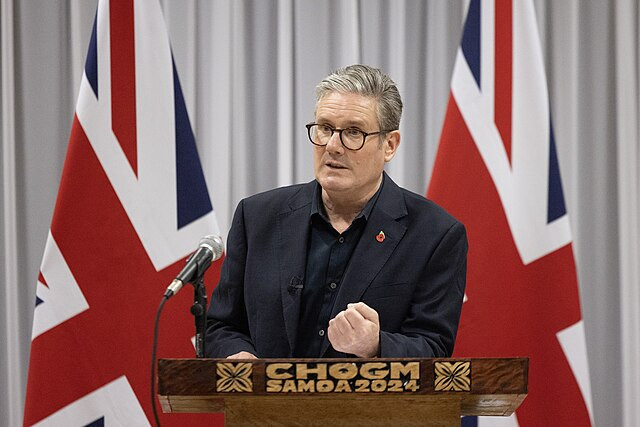
Britain's proposal to deploy troops to Ukraine as part of a postwar security arrangement has triggered one of Moscow's sharpest responses yet, underscoring how any Western military footprint on Ukrainian soil remains a red line for the Kremlin. Russian officials framed Prime Minister Keir Starmer's plan as an existential provocation, warning that London would face severe consequences if it attempted to follow through.
The most explicit threat came from Dmitry Rogozin, a senior Russian senator and longtime ally of President Vladimir Putin. In a statement circulated by Russian media, Rogozin dismissed Starmer personally and escalated to a warning aimed at the UK itself. "Of course, Starmer is illiterate and a fool in the grand scheme of things, but he should still understand what we will do to their s***** kingdom if they actually try to implement this nonsense," Rogozin said.
The rhetoric marked a notable intensification from Moscow, signaling that British participation in any Ukraine stabilization force would be treated not as neutral peacekeeping but as hostile intervention. Russian officials have repeatedly warned NATO states against placing forces in Ukraine, even after the war's active phase, arguing such moves would expand the conflict rather than contain it.
The confrontation unfolded as Putin appeared at a midnight Orthodox Christmas service attended by senior Russian military and intelligence figures, including generals from the GRU. Speaking at the service, Putin framed the war in explicitly spiritual terms, casting Russia's campaign as a sacred obligation. "The soldiers of Russia always, as if on the Lord's orders, fulfil this very mission - the defence of the Fatherland, the salvation of the Motherland and its people," Putin told the assembled officers.
That language, analysts say, reflects a Kremlin narrative that increasingly portrays the war as divinely sanctioned rather than politically contingent. By invoking religion before military elites, Putin reinforced the idea that retreat or compromise would amount to moral and spiritual failure, not simply strategic recalibration.
Within hours of the service, Russian forces carried out renewed strikes across Ukraine. Regional authorities reported civilian injuries in Dnipro, including two girls aged eight and sixteen, after residential areas were hit. Additional strikes in Zaporizhzhia wounded more children, according to local officials.
Ukraine responded with its own cross-border attack, targeting an oil facility in Russia's Belgorod region. Governor Vyacheslav Gladkov described the blaze at the Stary Oskol plant as a "spectacular inferno," saying multiple fuel tanks caught fire as emergency crews struggled to contain the damage.
The fighting continues to exact a heavy toll on civilian infrastructure. Power shortages linked to sustained Russian missile and drone strikes forced hospitals in Lviv to disconnect from the electricity grid, further straining an already overburdened healthcare system.