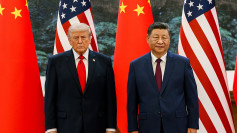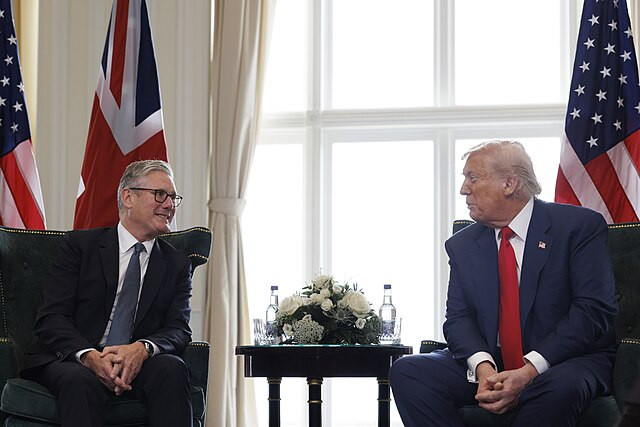
A major new report is forcing British defence planners to confront a once-unthinkable scenario: a future in which the United States may no longer be relied upon to defend the United Kingdom in a major conflict. The study, released on Jan. 27, 2026, argues that President Donald Trump's "America First" doctrine has eroded the postwar security assumptions underpinning British strategy, leaving the UK exposed as tensions with Russia intensify.
The report, Understanding the UK's Transition to Warfighting Readiness, was produced by the think tank Civitas and co-authored by Conservative MP Sir Bernard Jenkin, Labour MP Derek Twigg and former NATO adviser Chris Donnelly. It warns that Britain's defence institutions remain trapped in what the authors describe as a "sclerotic" peacetime mindset, ill-suited to the "kinetic" realities of modern warfare.
At the core of the paper is a stark reassessment of NATO's collective defence guarantee. The authors argue that Article 5, long treated in London as an ironclad insurance policy, can no longer be assumed to function automatically under the current U.S. administration. They write that Washington is increasingly acting in ways "contrary to the interests" of its allies and caution that American priorities have shifted decisively inward.
The report goes further, suggesting that the White House now views Moscow less as a strategic adversary than as a "potential business partner," pointing to signs of commercial normalization between the two powers. That assessment, the authors say, fundamentally alters the strategic calculus for European allies that have relied on U.S. leadership to deter Russian aggression.
Lord Robertson of Port Ellen, the former NATO secretary-general who wrote the report's foreword and led the UK government's recent defence review, offered a blunt warning. He said Britain is "under-prepared and under attack," arguing that the threat of conflict is more immediate than policymakers acknowledge. He criticized recent defence planning for focusing too heavily on long-term modernization rather than the "here and now."
One of the most pressing vulnerabilities identified is manpower. Allied officials, the report notes, have expressed alarm at the size of the British Army, which has shrunk to roughly 70,000 regular troops. Official figures show fully trained regular forces fell to about 66,250 in late 2025, their lowest level in centuries.
The authors argue that while Britain has invested heavily in advanced platforms and digital capabilities, "mass still matters" in high-intensity conflict. Drawing lessons from Ukraine, they warn that current force levels would struggle to sustain prolonged combat.
To address the gap, the report calls for a "comprehensive societal mobilisation," including reforms to education, civil resilience and cyber security. It also raises the politically sensitive idea of "war-capable political processes," referencing the flexible governance and national service frameworks adopted by countries such as Sweden and Norway.
Although compulsory military service ended in the UK in 1963, the Civitas authors suggest the scale of the current threat requires reopening debates long considered taboo. They also urge London to diversify its security partnerships, naming India as a potential strategic counterweight, while overhauling what they describe as a risk-averse governance culture.