Prince Harry has renewed his public advocacy around Africa by tying environmental preservation in the Okavango Delta to the humanitarian legacy of his late mother, Princess Diana, in a foreword for a forthcoming National Geographic book. The Duke of Sussex's contribution appears in Okavango and the Source of Life: Exploring Africa's Lost Headwaters, by National Geographic explorer Steve Boyes, due for release on March 3, 2026, underscoring Harry's long-standing connection to the continent he has called his "second home."
The foreword situates Harry's environmental work within a deeply personal narrative, linking the Okavango River's pristine headwaters to Diana's landmark 1997 walk through a live minefield in Huambo, Angola. That moment, widely credited with shifting global attention to the dangers of landmines, took place only miles from the sources of the Okavango, according to Harry's account.
The book, published by the National Geographic Society and Disney Publishing Worldwide, spans 224 pages and includes roughly 200 color photographs. Through more than 100 images and detailed maps, it documents the Okavango Wilderness Project's efforts to protect what the publisher describes as one of the world's last remaining primeval ecosystems.
Harry writes that Diana's humanitarian work continues to shape his own commitments. By supporting the HALO Trust, which managed the original mine clearance in Angola, he frames a continuum between efforts to protect people from "lethal devices" and campaigns to safeguard the life-sustaining waters of the delta. In July 2025, Harry returned to Angola and walked through a cleared minefield in Cuito Cuanavale, reaffirming his pledge to a mine-free future.
Africa's role in Harry's personal life also figures prominently. He recounts decades of returning to the Okavango Delta, describing it as an "enigmatic wetland" and a "paradise" where he has escaped to be "enveloped by nature's sheer magnificence" for more than 25 years. The region, he notes, supports the world's largest remaining elephant population, as well as lions and hundreds of rare bird species.
The Duke's writing broadens into a warning about environmental stakes. "As wildfires rage and hurricanes tear apart entire peninsulas, we're faced with a harsh reality: a climate crisis and a mass extinction that can no longer be ignored," he writes, framing conservation not as an abstract ideal but as a necessity for "our collective survival."
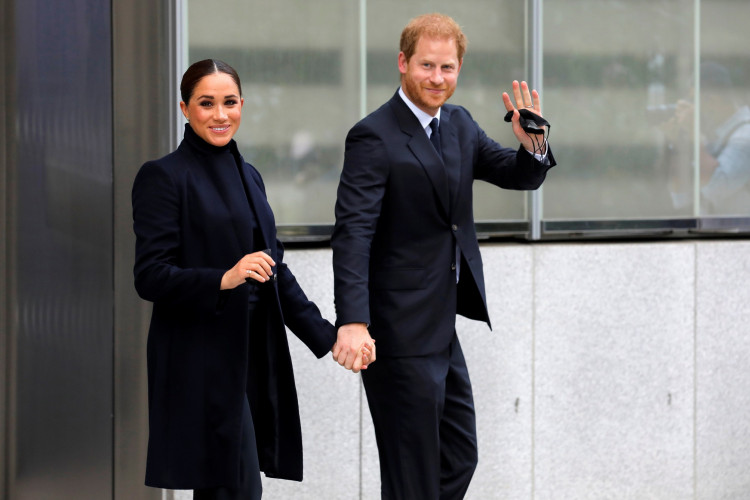
Harry has long spoken about Africa as a place of refuge after Diana's death. Reflecting on his early visits at age 12 or 13, he has said, "I feel more like myself there than anywhere else in the world." The continent also played a pivotal role in his relationship with Meghan Markle, when he took her to Botswana early in their courtship, away from public scrutiny.
At a 2024 panel discussion in Miami, Harry distilled that bond succinctly: "Africa's in my heart, and Africa's in my soul." By lending his voice to Boyes's work, the Duke positions the Okavango not only as a conservation priority, but as a living link between personal healing, inherited responsibility and a broader environmental mission shaped by his mother's legacy.