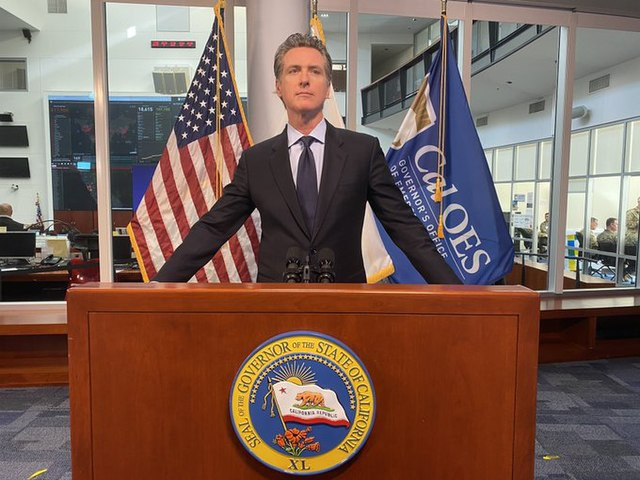
California Gov. Gavin Newsom on Friday urged President Donald Trump to return what he said amounted to $1,751 per American household after the Supreme Court struck down key tariffs imposed under the International Emergency Economic Powers Act, escalating a political and legal battle over who ultimately bore the cost of the trade measures.
The Supreme Court's 6-3 decision held that Trump exceeded his authority under IEEPA by imposing sweeping import duties without explicit congressional approval. The ruling invalidated major components of the tariff program affecting imports from China, Mexico and Canada, reinforcing Congress's constitutional authority over taxation and trade.
Newsom characterized the tariffs as an "illegal cash grab" and argued they functioned as a hidden tax on consumers and small businesses. Citing research referenced by his office, he said the average American family absorbed roughly £1,450 ($1,751) in additional annual costs as companies passed along higher import expenses through retail prices.
The economic mechanics are straightforward but politically volatile. Tariffs are paid at the border by importers, yet most economists agree the burden largely shifts downstream.
Estimates cited in the debate suggest:
- Approximately 96% of tariff costs were borne by U.S. importers and consumers
- The average household impact was about $1,751 annually
- Billions of dollars were collected under the invalidated measures
Whether that money can be refunded directly to households remains uncertain.
The Supreme Court did not address reimbursement mechanisms in its opinion. Instead, the justices focused narrowly on statutory authority, concluding that IEEPA does not authorize unilateral tariff imposition. The absence of guidance leaves lower courts and federal agencies to determine whether importers are entitled to refunds and, if so, how those funds would flow through the economy.
Trade lawyers note that importers who paid duties to U.S. Customs and Border Protection may seek refunds through administrative or judicial channels. However, consumers who paid higher prices at retail counters lack a direct statutory pathway for reimbursement unless companies voluntarily pass refunds along.
Online forums have reflected the complexity of the issue. One commenter wrote that tariffs "function not as a tax on foreign producers, but as a consumption tax on Americans." Others questioned whether any recovered funds would ever trickle back to households absent further litigation.
Critics of Newsom's proposal dismissed it as political messaging, arguing that tariff pass-through effects vary by industry and that calculating precise household losses is imprecise. Supporters counter that the broader economic drag extended beyond official figures, affecting groceries, appliances and other everyday goods.