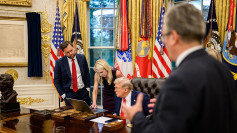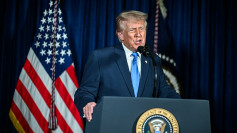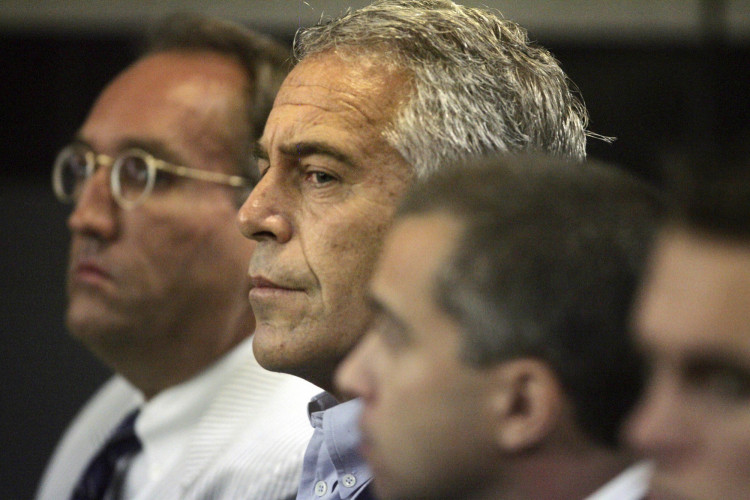
The U.S. Department of Justice has removed tens of thousands of records from its public database of Jeffrey Epstein documents, drawing bipartisan scrutiny in Washington after reports that some of the missing material includes FBI interview records referencing unverified allegations involving President Donald Trump.
The scale of the withdrawal emerged after the database-created under the Epstein Files Transparency Act-was found to be missing tens of thousands of records originally included in a massive public release earlier this year. According to figures confirmed by the Justice Department, 47,635 files were taken offline pending further review.
A Justice Department spokesperson acknowledged the removal after inquiries from reporters, stating: "47,635 files were offline for further review and should be ready for re-production by the end of the week."
The department has not detailed which categories of records were removed or why the files were withdrawn after publication. The move has intensified debate over transparency obligations under the law signed by Trump in 2025 requiring the disclosure of government-held records related to Epstein.
The broader database was one of the largest public releases tied to the long-running Epstein investigation. On Jan. 30, 2026, the Justice Department published a massive trove of records that included:
- More than 3 million pages of documents
- About 180,000 images
- Roughly 2,000 videos
Pulling nearly 48,000 records from that archive represents a significant portion of the material previously made accessible to the public.
Under Public Law 119-38, the Epstein Files Transparency Act contains strict disclosure requirements. The statute states that records cannot be withheld or delayed "on the basis of embarrassment, reputational harm, or political sensitivity, including to any government official, public figure, or foreign dignitary."
The law allows limited exceptions, including the protection of victims' personal identifying information, materials tied to active investigations, graphic evidence of violence and classified national-security content.
The controversy intensified after journalists identified gaps in certain FBI records associated with the case. NPR reported that analysis of the database's serial numbering system-known as Bates stamps-indicated missing interview materials.
NPR's Stephen Fowler described the discrepancy as "highly unusual," noting that gaps in the numbering suggested certain documents had been catalogued but not published.
According to the outlet's reporting, approximately 53 pages of FBI interview notes and documents appear to be missing from the public database. Those records relate to interviews with a woman who accused Epstein and Trump of sexual assault in the 1980s, allegations that remain unverified.
The accuser's claims against Epstein were included in a civil lawsuit filed in 2019 under the pseudonym "Jane Doe 4." Trump has repeatedly denied any wrongdoing in connection with Epstein.
A separate review by CNN reportedly found that three FBI interviews with the accuser reference allegations involving Trump, while the only interview released publicly did not address those claims.
Other files connected to the Epstein investigation have also drawn attention. Some documents related to a key witness in the criminal case against Epstein associate Ghislaine Maxwell, who is currently serving a 20-year prison sentence for sex trafficking, were temporarily removed and later restored.
One reinstated document included an interview with the mother of an accuser referencing visitors to Epstein's residence, mentioning "a 'prince and DONALD TRUMP' visiting Epstein's house."
The Justice Department has defended its handling of the database while rejecting accusations that politically sensitive records were deliberately concealed. In response to earlier reporting, the department said "ALL responsive documents have been produced" unless they fall under exemptions such as duplicates, privilege claims or ongoing investigative materials.
Later, the department said it had begun reviewing certain records tied to the Maxwell case after concerns about redactions and missing materials surfaced.
The department also criticized lawmakers raising questions about the database. In a post on X, officials wrote that Oversight Democrats "should stop misleading the public."
The dispute has already reached Congress. Rep. Robert Garcia of California, the ranking Democrat on the House Oversight Committee, said his office conducted its own review of the database.
Garcia said investigators "can confirm that the DOJ appears to have illegally withheld FBI interviews with this survivor who accused President Trump of heinous crimes."