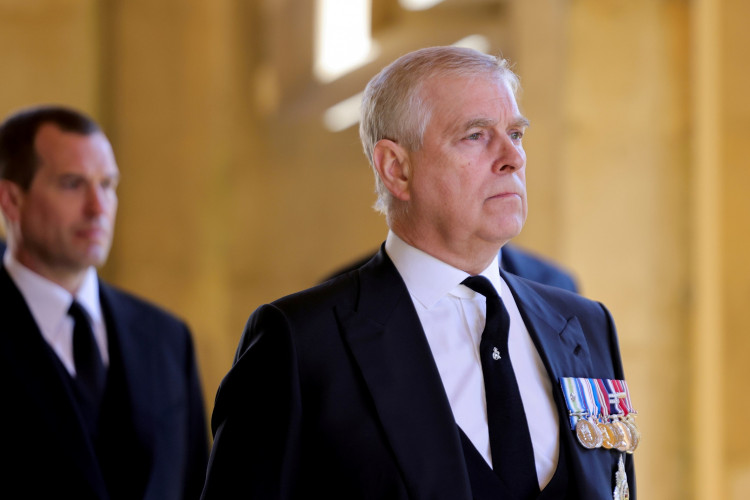
Prince Andrew's long-running Epstein scandal drew a fresh and incendiary accusation in March after royal historian Andrew Lownie said at the Oxford Literary Festival that the former Duke of York "bullied" Queen Elizabeth II into protecting him, framing the affair as a deeper institutional wound for the monarchy than the abdication crisis of 1936.
The remarks landed at a moment when scrutiny of Andrew had already intensified. Weeks earlier, he had been arrested on his 66th birthday in February on suspicion of misconduct in public office, according to the article, and police have since indicated that their inquiry could widen to include other potential corruption offenses. Buckingham Palace was approached for comment and had not responded by publication time.
Lownie, whose 2025 biography Entitled examined Andrew and Sarah Ferguson, used the Oxford event to argue that Andrew's association with Jeffrey Epstein had inflicted a form of reputational damage more corrosive than the crisis surrounding Edward VIII. In Lownie's telling, the abdication of 1936, though historic, did not carry the same sustained public fury because many people at the time did not fully grasp its long-term implications.
He described Edward VIII's abdication as a "three-day wonder" for many ordinary Britons. Andrew's case, by contrast, has unfolded as a prolonged and globally recognized scandal, one that forced the institution into a far more defensive posture. Edward stepped aside voluntarily; Andrew, as the article notes, was stripped of his HRH title and military honors only after his ties to Epstein became impossible for the royal household to contain.
Lownie's sharpest allegations concerned the late Queen herself and the court around her. He told the festival audience that by the end of her life Elizabeth was "completely gaga," and argued that King Charles had effectively been managing the institution for years before her death in September 2022. He then alleged that Andrew exploited that vulnerability. "He would go up there and he would bully her into doing things," Lownie said.
He also claimed that warnings had circulated inside official channels without producing action. "There were MI6 officers who went to private secretaries and said, 'Look, he's been caught with $5 million in a suitcase in Kazakhstan,'" Lownie told the audience, "and they were sent away with a flea in their ear." He added that senior Foreign Office figures had also made complaints. No documentary evidence for that Kazakhstan allegation was presented in the material provided.
Lownie went further still, placing responsibility not only on Andrew but on the institution that surrounded him. "She, I'm afraid, abetted this," he said of Queen Elizabeth. "The whole family abetted this. They knew about it." Those claims, as presented in the article, remain allegations. The Palace did not issue a public reply, and no corroborating records were cited in the source material.
The broader collapse of Andrew's public standing has not been driven by one episode alone. The article traces it through the 2019 BBC interview in which he denied wrongdoing and showed, in the view of many critics, little sympathy for Epstein's victims. That appearance hardened public opinion and made Andrew's return to any meaningful royal role politically untenable.
The scandal deepened further in 2021 when Virginia Giuffre filed a civil lawsuit accusing Andrew of rape and sexual abuse when she was 17. He denied the allegations. The case was settled out of court in 2022 on undisclosed terms, but the settlement did little to close the reputational damage.