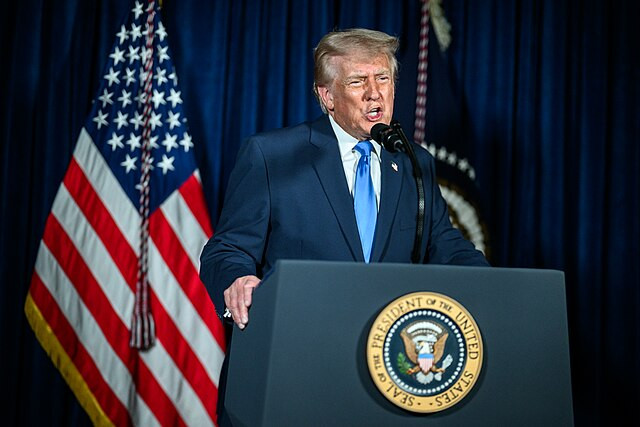
Donald Trump told supporters at a Republican fundraiser in Washington that Iran had, in his words, effectively offered him the role of supreme leader-an assertion that has drawn scrutiny amid escalating conflict involving the United States, Israel and Iran and a lack of confirmation from Tehran.
"I said, 'No, thank yo' I don't want it,'" Trump said during the event, delivering the remark in his characteristic off-the-cuff style. The statement, made without elaboration or supporting detail, quickly circulated in political and media circles as tensions in the Middle East continue to intensify.
The claim emerged at a moment of heightened geopolitical volatility, following weeks of military escalation between U.S. and allied forces and Iran. Reports of leadership disruption in Tehran, including the death of Supreme Leader Ali Khamenei during joint airstrikes and the subsequent rise of his son, Mojtaba Khamenei, have further destabilized the region and reshaped the strategic landscape.
Trump's remarks also intersect with conflicting narratives about diplomatic engagement. He suggested at the fundraiser that Iran is seeking an agreement with Washington but is constrained by internal pressures. That characterization contrasts sharply with statements from Iran's foreign ministry.
Seyed Abbas Araghchi has denied that direct negotiations are taking place, acknowledging only indirect communications through intermediaries. The divergence underscores the opacity surrounding any potential diplomatic channel, with both sides presenting markedly different accounts of their intentions.
Observers note that Trump's statement about being offered Iran's top leadership role stands apart even within his history of unconventional rhetoric. No Iranian official has publicly acknowledged or substantiated the claim, leaving it unverified in both diplomatic and intelligence channels.
The episode highlights how political messaging continues to shape perceptions of the conflict. Fundraiser remarks, often tailored to domestic audiences, can carry outsized impact when they intersect with active geopolitical crises. By portraying Iran as simultaneously adversarial and, in his telling, deferential, Trump reinforces a narrative of U.S. dominance while introducing an element of spectacle.
At the same time, analysts warn that such statements risk complicating already fragile diplomatic dynamics. The gap between public rhetoric and verifiable developments can obscure the actual state of negotiations, particularly in a conflict where indirect communication and signaling play a central role.