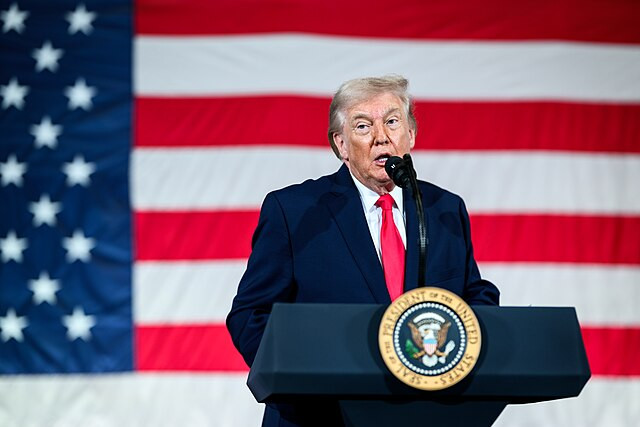
President Donald Trump has ignited a new foreign policy controversy after stating in a televised interview that the United States supplied weapons to anti-government protesters in Iran-only for those arms to allegedly be diverted before reaching their intended recipients.
"We sent them a lot of guns. We sent them through the Kurds. And I think the Kurds kept them," Trump said, offering one of the clearest public acknowledgments to date of U.S. involvement in efforts to support unrest inside Iran. The remarks have raised questions about operational oversight and the risks of channeling weapons through non-state intermediaries.
The comments come as tensions between Washington and Tehran remain elevated following months of unrest and military escalation. Analysts say Trump's statement, if accurate, signals a more direct role in internal Iranian dynamics than previously confirmed by officials.
The protests referenced by Trump began on Dec. 28, 2025, in Tehran and rapidly spread nationwide after a sharp economic downturn triggered widespread dissatisfaction. Demonstrations initially centered on inflation and currency collapse but evolved into broader calls for systemic political change.
The Iranian government responded with force. Reports indicated thousands of casualties during the crackdown, with Ali Khamenei acknowledging significant losses before his death in February 2026. Independent estimates suggested the toll may have been higher, underscoring the scale of the unrest.
Trump's assertion that weapons were routed through Kurdish intermediaries introduces a complex geopolitical dimension. Kurdish groups operate across Iran, Iraq, Syria and Turkey, often balancing competing alliances and interests. Their involvement in any covert supply chain would highlight the reliance on regional actors with independent agendas.
The claim that those weapons may have been retained by Kurdish factions has intensified scrutiny among policy experts. The use of intermediaries in conflict zones carries inherent risks, including diversion, loss of control and unintended escalation.
Several analysts point to three key concerns raised by the remarks:
- Lack of verifiable oversight over weapons distribution
- Potential strengthening of non-state armed groups
- Increased volatility in an already fragile regional security environment
The admission also touches on longstanding debates within U.S. foreign policy circles regarding intervention in internal uprisings. While support for opposition movements has been a recurring strategy, the mechanics of such operations-particularly when involving arms transfers-are typically shielded from public disclosure.
Trump's comments break from that tradition, offering an unusually direct account that has prompted calls for clarification. Critics argue that acknowledging such actions publicly could complicate diplomatic relations and potentially expose operational vulnerabilities.
At the same time, the statement may reshape perceptions of the protest movement itself. If external weapons were introduced, it could alter how both domestic and international observers interpret the trajectory of the unrest, particularly its shift from demonstrations to violent confrontation.