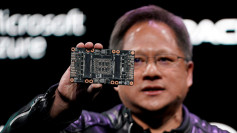
Nvidia CEO Jensen Huang said Saturday that China remains part of the company's projected $200 billion CPU market opportunity, underscoring how central the Chinese technology sector still is to Nvidia's long-term growth strategy despite escalating U.S.-China semiconductor restrictions.
Speaking in Taipei ahead of the annual Computex conference, Huang was asked whether the massive CPU opportunity he described earlier this week included China. "I would think so," Huang replied, according to Reuters, signaling that Nvidia still expects demand from Chinese customers even as Washington tightens export controls on advanced artificial-intelligence technology.
The comments come at a pivotal moment for Nvidia, which is attempting to broaden its business beyond the graphics processing units, or GPUs, that turned the company into the dominant supplier powering the global AI boom.
During Nvidia's earnings call earlier this week, Huang said the company's new Vera CPU architecture opens access to a market worth roughly $200 billion. The strategy reflects Nvidia's push to build complete AI computing systems rather than relying solely on its flagship accelerators.
Reuters reported that Huang has increasingly emphasized CPUs and integrated computing platforms as businesses adopt more advanced "agentic AI" systems capable of performing autonomous tasks, a shift expected to increase demand for a wider range of computing infrastructure.
China remains one of the world's largest potential AI markets despite mounting geopolitical friction between Washington and Beijing.
The United States has imposed sweeping export restrictions on advanced semiconductor technology over the past several years, limiting Chinese access to cutting-edge AI chips. In response, Beijing has accelerated efforts to build domestic alternatives and reduce dependence on American semiconductor firms.
Even so, Nvidia continues to pursue business opportunities inside China where regulations permit.
"H200 has been licensed to ship to China. It would be terrific to be able to serve that market. The Chinese market is very important. It's very large, of course," Huang said in Taipei, according to Reuters.
Earlier this month, Reuters reported that around 10 Chinese companies had received approval from U.S. authorities to purchase Nvidia's H200 chips, currently considered the company's second-most-powerful AI processors available for export. However, no shipments had reportedly been completed as of Saturday.
The issue has become increasingly tied to broader diplomatic tensions between the United States and China over artificial intelligence, national security and supply-chain dominance.
Earlier this month, President Donald Trump and Chinese President Xi Jinping held talks in Beijing, though Reuters reported no immediate progress emerged regarding Nvidia's efforts to expand H200 sales in China. Huang joined the U.S. delegation during the trip.
Taiwan also remains essential to Nvidia's manufacturing operations.
Huang said he plans to meet executives from TSMC, the world's largest contract chipmaker and Nvidia's key production partner for advanced processors. He added that Nvidia is ramping up production of its Vera Rubin platform, which combines the company's Vera CPU with Rubin GPU technology.
The expansion is expected to generate additional demand across Taiwan's semiconductor supply chain, further strengthening the island's role at the center of the global AI hardware race.
Competition among American chipmakers is also intensifying.
Earlier this week, AMD announced plans to invest more than $10 billion into Taiwan's AI ecosystem, according to The Wall Street Journal, highlighting the growing battle among semiconductor giants to secure manufacturing capacity and capture AI-related demand.
Huang also addressed concerns surrounding illegal diversion of advanced AI hardware after Taiwanese prosecutors launched an investigation into three individuals accused of exporting AI servers containing Nvidia chips in violation of U.S. export rules.
The servers were reportedly manufactured by Super Micro Computer.