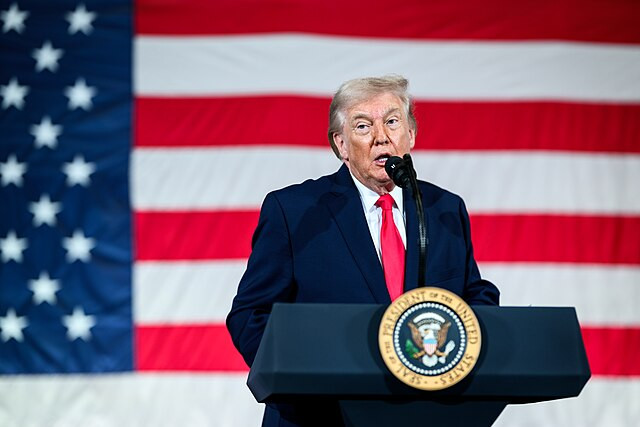
A group of Democratic lawmakers, led by Ed Markey, is calling for the impeachment of Donald Trump following his recent statements on Iran, intensifying a constitutional confrontation in Washington over war powers and presidential authority amid an ongoing conflict in the Middle East.
The push follows a Truth Social post in which Trump warned that "a whole civilisation will die tonight, never to be brought back again" if Iran failed to reopen the Strait of Hormuz, a critical global energy corridor. The statement has drawn sharp criticism from lawmakers who argue the language and policy direction raise legal and constitutional concerns.
Markey described the president as "completely unstable and dangerous" in a video statement, adding, "A war powers resolution will not be enough." He continued, "Yes. We need to assert congressional authority and stop this illegal war in Iran. But, Trump is clearly an unstable warmonger at odds with the will of the people. Removal is the top priority. No more war criminal in the White House."
The senator later escalated his rhetoric, calling Trump a "war-hungry madman at odds with the American people," and argued that impeachment should take precedence over narrower legislative remedies.
Other lawmakers have echoed those concerns. Ro Khanna said that "threatening war crimes is a blatant violation of our constitution and the Geneva Conventions," while Jim McGovern urged immediate action within the administration. Some Democrats have also raised the possibility of invoking the 25th Amendment as an alternative mechanism to remove the president.
The criticism has extended beyond party lines. Marjorie Taylor Greene, typically aligned with Trump, broke with the president's approach, arguing he was elected "to end America's involvement in foreign wars" and not "to kill an entire civilisation while waging a foreign war on behalf of Israel."
The dispute centers on both rhetoric and legal authority. Lawmakers are advancing a war powers resolution aimed at restricting U.S. military engagement in Iran, reflecting longstanding tensions between Congress and the executive branch over control of armed conflict. However, Markey and others argue that legislative limits alone are insufficient given what they characterize as the severity of Trump's actions.
Under the U.S. Constitution, impeachment would require approval by the House of Representatives followed by a Senate trial to determine removal. The 25th Amendment provides a separate pathway, allowing the vice president and a majority of the Cabinet to declare a president unable to perform the duties of the office.
The political pressure coincides with escalating military activity abroad. Since late February, U.S. and Israeli operations against Iran have triggered retaliatory missile and drone strikes across the region, including attacks affecting Israel and Gulf states. The conflict has disrupted energy markets and heightened global security concerns.
A fragile ceasefire is now in place, with Iran agreeing to coordinate vessel passage through the Strait of Hormuz during a temporary pause. The Trump administration has framed the reopening of the route as a central strategic objective.
Diplomatic efforts are tentatively resuming. Pakistan has invited both sides to talks in Islamabad, with senior U.S. officials, including JD Vance and envoy Steve Witkoff, expected to participate. The initiative signals an attempt to stabilize the situation through negotiation even as military tensions persist.