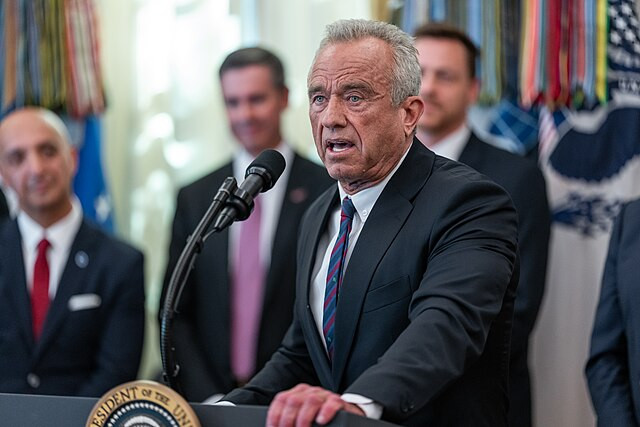
Robert F. Kennedy Jr. faced sharp bipartisan scrutiny during a Senate Finance Committee hearing after defending Donald Trump's repeated claim that his administration's TrumpRx program has reduced prescription drug prices by as much as 600%, a figure widely challenged by lawmakers and experts as mathematically impossible.
Testifying before the Senate Finance Committee on April 22, 2026, Kennedy argued that Trump applies a nonstandard method of calculating percentage reductions. Pressed by Elizabeth Warren, Kennedy said, "President Trump has a different way of calculating. There's two ways of calculating percentages. If you have a £480 ($600) drug and you reduce it to £8 ($10), that's a 600 per cent reduction."
The explanation immediately drew criticism from lawmakers and analysts, who pointed out that standard arithmetic would place such a reduction at approximately 98.3%. Warren responded bluntly: "I think that means companies should be paying you to take their drugs." Her comment underscored broader concerns that the administration's messaging may be detached from widely accepted economic and mathematical frameworks.
The hearing also featured criticism from Ron Wyden, who characterized the broader policy in stark terms, stating: "There is no bigger fraud on the planet when it comes to drug costs than Donald Trump." Wyden's remarks reflected ongoing Democratic opposition to the TrumpRx initiative, which they argue disproportionately benefits pharmaceutical companies.
Outside Congress, the exchange quickly spread across social media, drawing responses from academic experts. Kit Yates, a mathematician at the University of Bath, wrote on X: "We've known for a while that the USA's current regime have been out for science, but I never thought they would try to mess with math! You can't just redefine how you calculate percentages."
Similarly, Professor Jeffrey S. Morris weighed in, stating: "That is an absurdly ignorant statement from RFK. It is a 98% reduction, or you could say an increase from $10 to $600 would be a 5,000% increase, or a 60-fold reduction. There is no way to come up with 600% anything based on these numbers."
The controversy traces back to Trump's earlier remarks in October 2025, when he told supporters: "Now drug prices are going to be going down 100 percent, 400 percent, 600 percent, 1,000 percent, in some cases." Fact-checkers, including CNN, have repeatedly challenged those claims, noting that reductions exceeding 100% would imply companies paying consumers to take medications.
Health policy experts have also questioned the practical meaning of such figures. Mariana Socal of Johns Hopkins University previously said: "I find it really difficult to translate those numbers into some actual estimates that patients would see at the pharmacy counter."
During the same hearing, Bernie Sanders challenged Kennedy's broader assertion that Americans are now paying the lowest drug prices globally, calling it "an absurd statement," and adding: "Nobody in the world believes that." Kennedy responded by urging lawmakers to act, saying: "You have a lot more power to negotiate. Why don't you just go do it?"