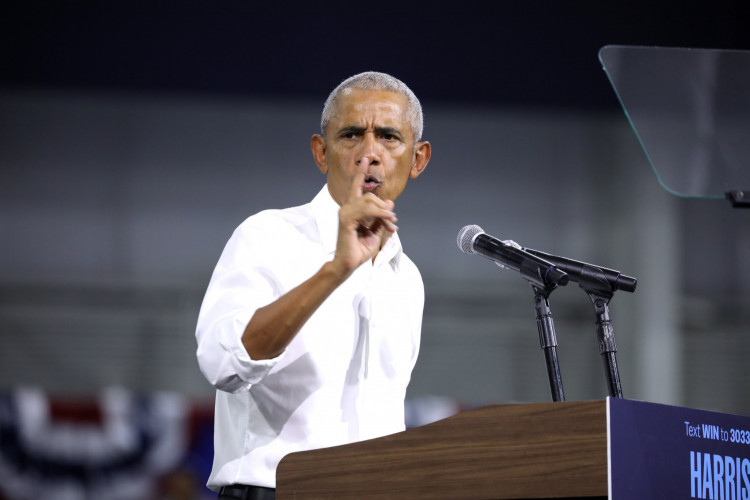
Barack Obama said his continued political engagement-particularly his opposition to Donald Trump-has placed strain on his marriage to Michelle Obama, offering a rare public acknowledgment of the personal toll tied to his post-presidential role.
In an interview with The New Yorker, Obama described the dynamic inside his household as increasingly complicated by his reentry into political debates. "She wants to see her husband easing up and spending more time with her, enjoying what remains of our lives," he said. "It does create a genuine tension in our household, and it frustrates her."
The remarks come as Obama has remained a prominent Democratic voice years after leaving office, campaigning in multiple election cycles and weighing in on high-profile political controversies. His continued visibility has coincided with renewed clashes with Trump, including recent criticism after Trump shared inflammatory social media content targeting Obama and his wife.
Obama suggested his involvement has been driven less by preference than by circumstance. He told The New Yorker that Trump's actions have drawn him back into public life "more than I would have preferred," framing his engagement as a response to political developments rather than a deliberate return to the spotlight.
At the same time, Obama pushed back on perceptions that he has been insufficiently vocal. "The media environment is so difficult that people don't even know all the stuff I am doing, right?" he said, indicating that much of his political activity occurs outside traditional public channels.
His approach has been measured compared with more outspoken commentators. "For me to function like Jon Stewart, even once a week, just going off, just ripping what was happening - which, by the way, I'm glad Jon's doing it - then I'm not a political leader, I'm a commentator," Obama said, outlining his reluctance to adopt a purely media-driven role.
Advisers say the strategy reflects broader changes in how political influence is exercised. David Plouffe, Obama's longtime strategist, told The New Yorker that modern audiences are less likely to seek out political messaging directly. "People who are going to be decisive in elections going forward do not seek out information about politics - they encounter it," Plouffe said, emphasizing the importance of indirect engagement.
Obama has expanded his reach through platforms beyond traditional politics, including media partnerships, podcasts, and digital collaborations. He has argued that effectiveness should be measured by audience engagement rather than frequency of public statements, even as critics call for a more aggressive posture.
His comments also revisited a long-standing leadership gap within the Democratic Party following his departure from office. In a prior interview on Marc Maron's WTF podcast, Obama said, "I leave office, and there's no obvious person who's now the shadow prime minister, the leader of the party for the Democrats," underscoring the vacuum he believes has prolonged his involvement.