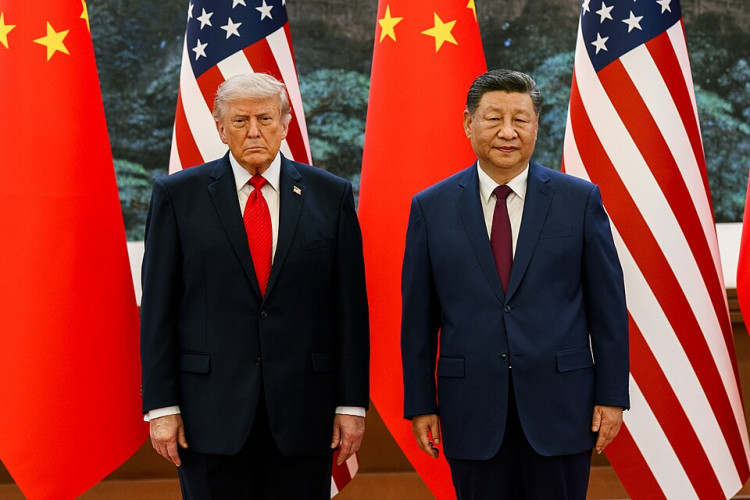
Donald Trump opened his high-stakes visit to Beijing this week by warmly praising Xi Jinping as a "great leader," a striking rhetorical pivot from years of branding China an "economic enemy" that had "ripped off the United States like no one has ever done before."
The two-day summit at the Great Hall of the People marks the most consequential face-to-face meeting between the American and Chinese leaders since Trump returned to office in January 2025 and launched the steepest tariff escalation in modern US-China history.
"You're a great leader. I say it to everybody," Trump told Xi during opening remarks before bilateral talks on 14 May, according to pool reports from inside the meeting hall. The president added: "We've had a fantastic relationship. We've gotten along - when there were difficulties, we worked it out."
Trump continued with unusually glowing language for a president whose political identity has long been tied to confrontational rhetoric toward Beijing. "Whenever we had a problem, we worked it out very quickly, and we're going to have a fantastic future together," he said.
The cordial atmosphere contrasted sharply with Trump's own earlier statements about China, many of which remain archived in official White House records. In a May 2020 address during his first administration, Trump declared: "For decades, they have ripped off the United States like no one has ever done before."
That same statement accused China of having "raided our factories, offshored our jobs, gutted our industries, stole our intellectual property, and violated their commitments under the World Trade Organisation."
The softer tone now emerging in Beijing follows an economically bruising confrontation between the world's two largest economies. After returning to office, Trump increased tariffs on Chinese imports to a cumulative 145% by April 2025, according to data tracked by the Tax Foundation. China retaliated with tariffs reaching 125% on American goods while also tightening controls over rare-earth mineral exports crucial to US manufacturing and defense industries.
The fallout rippled across global supply chains:
- US imports from China fell to roughly half their previous-year levels by mid-2025, according to the Peterson Institute for International Economics
- American exports to China declined 26% in nominal terms over the year
- Tariff levels were later partially reduced to 30% on the US side and 10% on the Chinese side under a temporary truce
Despite the tensions, Trump arrived in Beijing accompanied by some of America's most influential corporate leaders, including Tim Cook, Elon Musk and Jensen Huang, underscoring how deeply intertwined US business interests remain with the Chinese market.
Chinese Premier Li Qiang separately met the executives and urged them to support the "healthy development" of US-China relations, according to Chinese government summaries of the meetings.
Trump's rhetorical reversal in Beijing also mirrors a pattern seen during his 2017 China visit. At that time, standing alongside Xi, Trump famously said: "I don't blame China," instead faulting prior American administrations for allowing trade imbalances to deepen.
Once back in Washington after that earlier trip, Trump resumed a far more confrontational stance, eventually launching the first phase of the US-China trade war. Analysts in both capitals are now watching to see whether the current diplomatic thaw proves similarly temporary.
Behind the ceremonial warmth, major strategic disagreements remain unresolved. According to a statement released by China's Foreign Ministry, Xi warned Trump directly during the talks that "The Taiwan question is the most important issue in China-US relations."
Chinese Foreign Ministry spokesperson Mao Ning later said mishandling Taiwan could trigger "clashes and even conflicts, putting the entire relationship in great jeopardy."
The US readout of the meeting omitted any reference to Taiwan, focusing instead on trade discussions and ongoing tensions involving Iran and the Strait of Hormuz. Trump's administration is reportedly seeking Beijing's cooperation, or at minimum its neutrality, as Washington navigates the broader regional crisis surrounding Iran.
The summit's symbolism has also become impossible to ignore domestically. For years, Trump rallied political supporters with warnings that China represented America's foremost economic adversary. He described Chinese trade practices in a 2015 interview as "the greatest theft in the history of the world" and later wrote in his book Crippled America that China had "destroyed entire industries."
Now, during a carefully choreographed visit through Beijing landmarks including the Temple of Heaven, Trump has adopted the language of partnership and mutual respect.
"It's great," Trump told reporters after touring the site with Xi. "Great place. Incredible. China's beautiful."