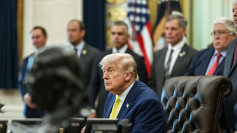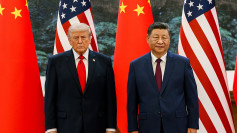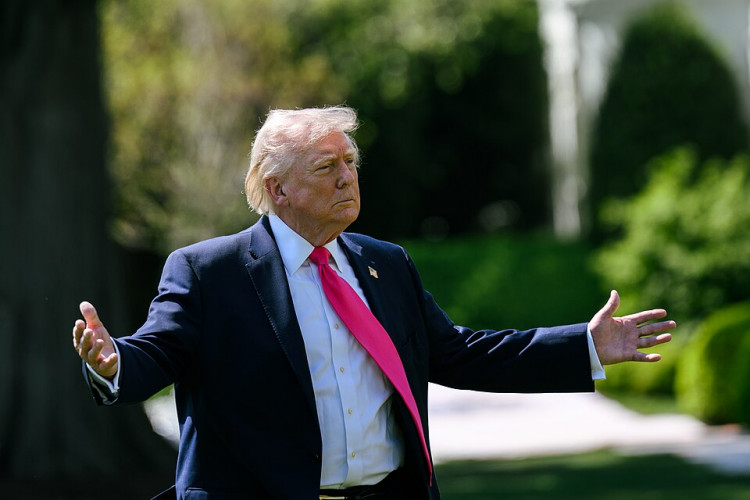
Donald Trump personally intervened to bring Jensen Huang into his high-profile delegation to Beijing after reports surfaced that the Nvidia chief executive had been excluded from the trip, according to multiple reports that revealed internal White House disagreement over the politically sensitive invitation.
The episode unfolded publicly Tuesday evening after Trump lashed out at media reports suggesting Huang had not been invited to join a group of American business leaders accompanying the president to meetings with Xi Jinping.
"CNBC incorrectly reported that the Great Jensen Huang, of Nvidia, was not invited to the incredible gathering of the World's Greatest Businessmen/women proudly going to China," Trump wrote on Truth Social.
"He is currently on Air Force One," Trump added, describing Huang as part of a delegation that included some of America's most powerful corporate executives.
Behind the scenes, however, White House officials acknowledged that Huang's participation had only materialized after last-minute intervention from the president himself.
A White House spokesman told Reuters that Huang's "schedule had changed" and that "it had worked out for him to attend." Bloomberg separately reported that Huang had not appeared on the official attendee list until Tuesday.
According to Euronews, Trump personally telephoned Huang after learning about coverage surrounding the Nvidia chief's absence and urged him to join the trip despite concerns raised by administration staff.
Those concerns reflected growing political tension inside Washington over Nvidia's business ties to China and the broader fight over advanced semiconductor exports.
Republican China hawks in Congress have increasingly criticized the administration for allowing Nvidia to continue selling modified artificial intelligence chips to Chinese companies while the US attempts to limit Beijing's technological advancement.
The debate has become central to the economic and geopolitical rivalry between Washington and Beijing, particularly as artificial intelligence systems emerge as a strategic battleground between the world's two largest economies.
Huang ultimately flew from California to Anchorage, where he boarded Air Force One during a refueling stop at Ted Stevens Anchorage International Airport before continuing on to China with the presidential delegation.
Images later showed Huang arriving in Beijing alongside executives including Elon Musk and Tim Cook.
An Nvidia spokesperson confirmed Huang's attendance in a statement to Euronews: "Jensen is attending the summit at the invitation of President Trump to support America and the administration's goals."
Trump, meanwhile, framed the business delegation as a symbol of American economic power. In his Truth Social post, he highlighted the presence of:
- Larry Fink of BlackRock
- Stephen Schwarzman of Blackstone
- Jane Fraser of Citi
- David Solomon of Goldman Sachs
- Kelly Ortberg of Boeing
- Cristiano Amon of Qualcomm
- Sanjay Mehrotra of Micron
The president said he intended to ask Xi "to 'open up' China so that these brilliant people can work their magic."
For Nvidia, the stakes surrounding the Beijing summit extend far beyond symbolism.
Huang has repeatedly described China as one of the company's most important long-term growth opportunities. He previously estimated that the addressable Chinese market for AI chips could reach $50 billion over the next several years and later suggested the opportunity might grow into "a couple of hundred billion dollars by the end of the decade."
Before export controls intensified, China accounted for roughly 13% of Nvidia's revenue. That share has since declined sharply under increasingly restrictive US semiconductor rules.
The Biden and Trump administrations alike imposed escalating controls limiting exports of Nvidia's most advanced AI processors to Chinese buyers. Nvidia's H200 chips remain barred from the market, and the company confirmed earlier this year that approved replacement products had not yet secured final authorization.
At the same time, Chinese technology giants including Huawei, Alibaba and ByteDance have accelerated efforts to develop domestic semiconductor alternatives in response to American restrictions.
Investors appeared encouraged by Huang's inclusion in the summit delegation. Nvidia shares rose roughly 3% Wednesday after reports confirmed the CEO's participation, adding an estimated $160 billion to the company's market value. Nvidia's market capitalization already exceeds $5 trillion.