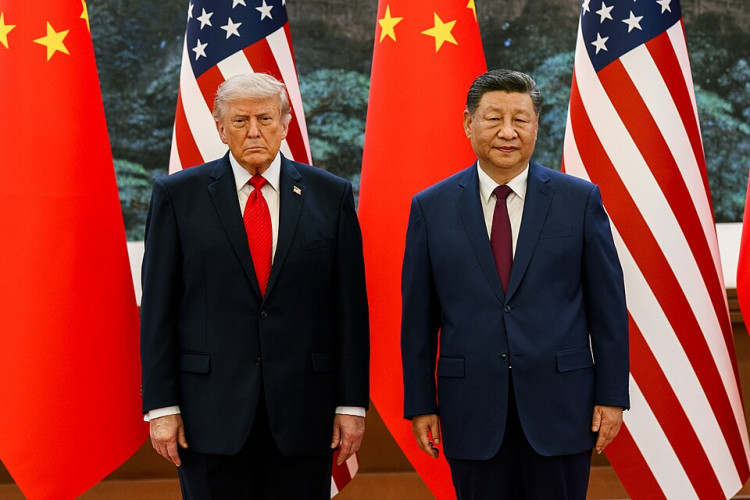
President Donald Trump and Chinese President Xi Jinping opened high-stakes talks in Beijing this week with lavish ceremony, warm public compliments and carefully choreographed symbolism. But by the end of a private meeting that reportedly lasted more than two hours, Trump appeared strikingly restrained, offering reporters only a terse remark about China's beauty after Chinese officials publicly emphasized Taiwan as the central issue in the negotiations.
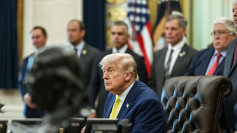
The meeting at Beijing's Great Hall of the People marked one of the most consequential diplomatic engagements between Washington and Beijing since Trump returned to office. Trump arrived Wednesday night alongside senior administration officials and a delegation of prominent American business leaders, including executives from the technology and semiconductor sectors, as both countries attempt to stabilize relations after years of tariff battles, export restrictions and rising military tensions in the Indo-Pacific.
Publicly, the opening moments projected warmth and stability. Chinese state ceremony surrounded the visit with military honors, red carpets and flag-waving children as Xi welcomed Trump to the capital. During opening remarks, Xi stressed the global significance of the encounter.
"The whole world is watching our meeting," Xi told Trump, according to the Chinese government's account of the session. He asked whether China and the United States could "meet global challenges together and provide more stability for the world."
Trump initially responded with the kind of personal praise he has often used with foreign leaders despite years of confrontational rhetoric toward Beijing. "You're a great leader, I say it to everybody, you're a great leader," Trump told Xi during the public portion of the talks.
The tone shifted noticeably after the leaders concluded their closed-door discussions.
According to The Daily Beast, the first session lasted approximately two hours and 15 minutes. Later, while appearing beside Xi at Beijing's Temple of Heaven, Trump gave an unusually abbreviated answer when reporters asked how the talks had gone.
"It's great, a great place. Incredible. China is beautiful," Trump said.
The exchange immediately drew attention because it contrasted sharply with Trump's typical public style. The president is known for lengthy improvisations, aggressive message control and expansive commentary during press gaggles, particularly after major diplomatic meetings. Instead, Trump offered no substantive remarks on trade, tariffs, Taiwan or military tensions before moving inside with Xi.
CNN White House reporter Betsy Klein described Trump as "uncharacteristically restrained" during the appearance, noting the president's unusual reluctance to elaborate publicly.
Chinese officials, meanwhile, moved quickly to frame the substance of the discussions around Taiwan. A Chinese foreign ministry spokesperson said Xi warned Trump that "the Taiwan question is the most important issue in China U.S. relations" and cautioned that mishandling the matter could lead to "clashes and even conflicts."
That language underscored Beijing's effort to place Taiwan at the center of the summit's geopolitical agenda, even as trade, artificial intelligence, Iran and semiconductor restrictions were also expected to dominate discussions.
One major unresolved issue hanging over the summit involves a proposed $14 billion US arms package for Taiwan. Congress has already approved the deal, but the Trump administration has not formally advanced the transfer. Trump had previously indicated he intended to discuss future Taiwan-related military sales directly with Xi during the Beijing visit, a move that raised concern among both Democrats and Republicans in Washington.
In a bipartisan letter dated May 8, US senators urged the administration to "make clear that America's support for Taiwan is inviolable." The lawmakers also pressed the White House to formally notify Congress regarding the arms package and warned against allowing Taiwan policy to become leverage in broader negotiations with Beijing.