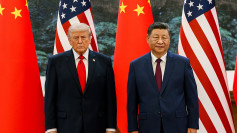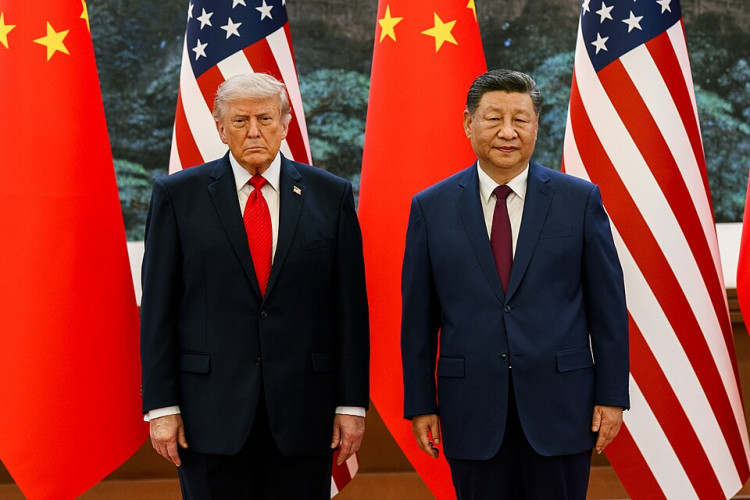
President Donald Trump spent Friday inside Beijing's tightly guarded Zhongnanhai leadership compound sharing a private lunch and walking tour with Chinese President Xi Jinping, while White House aides, embassy staff and reporters waited outside in parked vehicles eating McDonald's delivered through van windows.
The unusual split-screen moment quickly became one of the defining images of Trump's three-day visit to China, highlighting both the carefully choreographed nature of the summit and the contrasting political styles of Washington and Beijing. Behind the walls of the Communist Party's historic leadership enclave, Xi offered Trump a highly symbolic display of personal hospitality. Outside, members of the American delegation passed around bags of burgers and fries while awaiting updates from talks largely hidden from public view.
The summit, Trump's first return trip to Beijing since re-entering the White House, was officially framed as an attempt to stabilize relations strained by tariffs, Taiwan tensions, semiconductor restrictions and conflict in the Middle East. Yet by Friday afternoon, the most vivid public takeaway was less about geopolitics than optics.
Reporters traveling with the White House pool described McDonald's meals arriving for staff and journalists confined to vehicles near Zhongnanhai while Trump's closed-door lunch with Xi stretched on behind heavy security. Several members of Trump's own traveling delegation reportedly remained outside the compound's inner areas during the meeting.
The imagery carried an unmistakable layer of irony given Trump's long association with the fast-food chain.
White House Chief of Staff Susie Wiles previously said Trump eats McDonald's daily, and the president has repeatedly incorporated the brand into his public persona. During the 2024 campaign, Trump staged a visit to a McDonald's drive-thru and later had the chain's food delivered to the Oval Office during an event promoting the elimination of taxes on tips for service workers.
In Beijing, however, it was everyone except Trump eating from the paper bags.
Inside Zhongnanhai, Xi led Trump through one of the Chinese Communist Party's most politically sensitive compounds. Once part of imperial-era gardens beside the Forbidden City, Zhongnanhai now functions as both a workplace and residence for China's top leadership.
"Zhongnanhai is where the CPC Central Committee and the State Council work, and it is also where I work and live," Xi told Trump, according to Chinese state media accounts. "After the founding of New China, Chinese leaders including Mao Zedong, Zhou Enlai and others all lived here."
Xi also emphasized the compound's historical symbolism during the walking tour, pointing out centuries-old trees lining the grounds.
"All these trees are 200 to 300 years old. There's a big one that's about 400 years old," Xi said. "There's even one that's 1,000 years old. It's somewhere else."
Chinese officials portrayed the invitation as a reciprocal gesture after Trump hosted Xi at Mar-a-Lago during his first presidency in 2017. This time, Xi controlled the setting entirely, inviting Trump into the physical and political center of Chinese Communist Party authority.
Trump, meanwhile, adopted a markedly quieter tone than usual throughout the trip.
The president, known for lengthy exchanges with reporters and constant social-media commentary, avoided answering shouted questions during appearances Thursday at the Temple of Heaven and again Friday entering and exiting Zhongnanhai. His Truth Social activity also slowed noticeably during the Beijing visit.
That restraint stood out because Trump rarely avoids public improvisation during major diplomatic travel. Some observers interpreted the quieter posture as an adaptation to Xi's tightly managed media style, which generally avoids unscripted interactions and limits press access.
Substantive details from the summit remained scarce by Friday evening.
Trump told Fox News the discussions touched on trade, aircraft purchases, soybeans and oil. He also claimed progress had been made on broader economic cooperation.
"A lot of good has come of it," Trump said, adding there were "some fantastic trade deals" that would be "great for both countries."
The talks also extended into international security matters. Trump said he and Xi discussed Iran and the Strait of Hormuz, where recent military escalation has threatened global energy markets.
"We feel very similar about (how) we want it to end," Trump said regarding Iran. "We don't want them to have a nuclear weapon."
He added that both sides wanted shipping routes reopened quickly after Iranian disruptions in the region.
"We want them to get it ended because it's a crazy thing there," Trump said. "A little bit crazy. And it's no good, it can't happen."