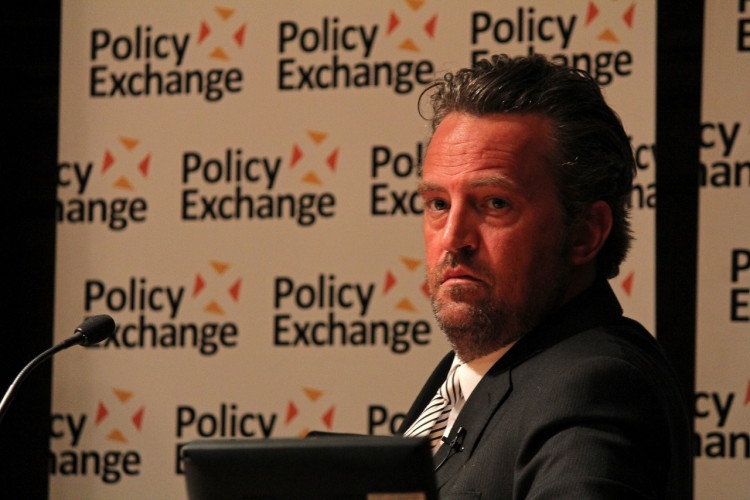
The family of Matthew Perry delivered searing victim impact statements in court ahead of the sentencing of the late actor's longtime assistant, Kenneth "Kenny" Iwamasa, accusing him of betraying the trust of a man who had publicly battled addiction for decades and ultimately "left him in a hot tub to die."
The filings, obtained by Page Six and tied to the federal investigation into Perry's October 2023 death in Los Angeles, laid bare the anger and devastation still gripping the actor's family nearly two years after authorities ruled he died from the "acute effects of ketamine," with drowning and other medical factors contributing.
At the center of the case is Iwamasa, Perry's former live-in assistant, who prosecutors say repeatedly injected the "Friends" star with ketamine outside any legitimate medical setting during the final days of his life.
Perry's sister, Madeline Morrison, accused Iwamasa of directly causing the fatal overdose while presenting himself to the family as a trusted caretaker.
"It is difficult to put into words the sense of betrayal I felt when I found out what Kenny had done," she wrote in her statement.
Madeline Morrison went further, alleging that Iwamasa "had injected my brother with a lethal dose of ketamine and left him in a hot tub to die."
Her statement also described what she viewed as deception in the aftermath of Perry's death. According to the filing, the family initially believed a version of events later contradicted by prosecutors and investigators.
"Everything I believed about the day he died, everything Kenny told us, was a lie," she wrote. "The idea that someone my brother considered family could betray him in such an unimaginable way is something I never could have conceived."
The emotional filings painted a picture not only of grief, but of a family struggling with the realization that someone deeply embedded in Perry's personal life allegedly became part of the network supplying him with dangerous drugs.
Madeline Morrison said one of the most haunting moments came during Perry's funeral service, where Iwamasa reportedly addressed mourners despite later becoming a central defendant in the criminal case.
"The person responsible for my brother's death stood up and addressed the people who loved him most," she wrote. "That is like a cruel joke I still struggle with. He didn't just take my brother's life, he tainted our final memories of saying goodbye."
Another sister, Caitlin Morrison, questioned whether the fatal dose was administered recklessly or intentionally, though she acknowledged she may never know the answer.
"But I know that when Kenny left the house, he was doing one of two things," she wrote. "He was either escaping from something he knew he had done or he was willfully abandoning a vulnerable person in a dangerous situation."
Their mother, Suzanne Morrison, focused on what she described as the collapse of the assistant's core responsibility: helping Perry maintain sobriety after years of addiction struggles that the actor openly documented in interviews and in his memoir.
"His number-one responsibility, ensure that Matthew remained what he wanted to be: drug free," Suzanne Morrison wrote.
She also described Iwamasa's behavior after Perry's death in unusually personal terms, writing: "And when he had killed my son, he kept a sharp eye on me."
Federal prosecutors later charged five people connected to the ketamine distribution network surrounding Perry before his death.
Those charged included:
- Kenneth Iwamasa, Perry's assistant
- Dr. Mark Chavez
- Dr. Salvador Plasencia
- Drug counselor Erik Fleming
- Jasveen Sangha, known by prosecutors as the "Ketamine Queen"
According to court filings, prosecutors alleged Perry had been obtaining ketamine through illegal channels even while undergoing legitimate ketamine infusion therapy under medical supervision.
Authorities said the criminal network exploited Perry's addiction vulnerabilities while profiting from escalating drug access in the weeks before his death.
Several defendants eventually entered guilty pleas or plea agreements. Dr. Mark Chavez received eight months of house arrest, while Erik Fleming was sentenced to two years in federal prison followed by supervised release. Dr. Salvador Plasencia received a 30-month prison sentence.
Jasveen Sangha received the harshest sentence - 15 years in prison - after prosecutors accused her of operating what they described as a ketamine trafficking business that supplied Perry shortly before his death.