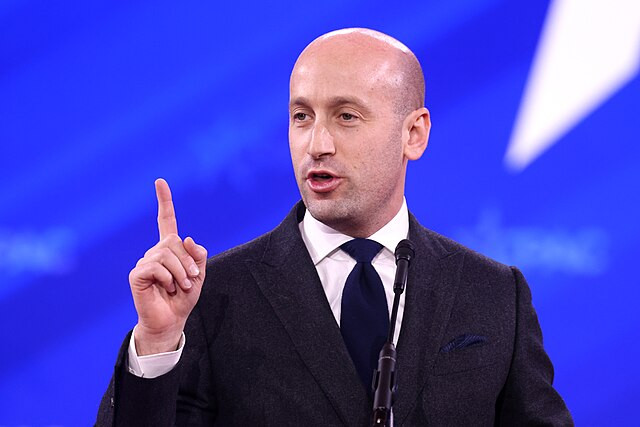
Former Trump adviser Stephen Miller and billionaire Elon Musk were thrust into a fresh social-media-driven controversy this week after influencer Ashley St. Clair alleged that Miller sent her messages referencing a "white boy" while also making a series of explosive claims about Musk's private political communications and personal conduct.
The allegations surfaced during a lengthy online interview that quickly ricocheted across X, podcasts and political commentary accounts, turning into one of the most heavily debated digital political stories of the week. Neither Miller nor Musk publicly addressed the specific claims as the discussion intensified online.
At the center of the uproar was St. Clair's assertion that Miller sent her a message stating, "we need white boy." She did not publicly release full context surrounding the alleged exchange, but screenshots and clips discussing the phrase spread rapidly across social media, where critics interpreted the wording through the lens of America's increasingly polarized debates over race, immigration and nationalist rhetoric.
The phrase itself became a political Rorschach test online. Opponents of Miller argued the alleged text reinforced longstanding concerns about the language and ideological tone associated with some figures in Trump-era conservatism. Supporters countered that the quote was fragmentary, lacked context and was being weaponized for outrage.
Miller has long occupied a central role in hardline immigration politics within Trump's orbit. As one of the most influential architects of the administration's border and deportation policies, he remains a lightning rod figure in conservative politics years after leaving the White House.
The controversy widened when St. Clair pivoted during the interview to her past interactions with Musk, describing what she portrayed as deeply unusual behind-the-scenes exchanges involving politics, money and influence.
According to St. Clair, Musk allegedly discussed major financial agreements tied to confidentiality and non-disparagement provisions. She also referenced text conversations she claimed occurred during the 2024 election cycle, though she did not provide independently verified documentation during the interview.
Her account portrayed Musk as a figure operating simultaneously across political influence, media power and private negotiations. The claims landed at a moment when Musk's political visibility has grown dramatically through his ownership of X and his increasingly outspoken role in American political discourse.
Musk's involvement in election conversations has already drawn scrutiny in recent years, particularly as he positioned himself as a major voice on free speech, censorship and government regulation online. That broader backdrop amplified the reach of St. Clair's allegations, even as key details remained unverified.
The interview also evolved into a wider critique of the conservative influencer ecosystem itself. St. Clair described what she characterized as a performative culture driven by loyalty, online engagement and status competition inside MAGA-aligned media spaces.
She alleged that some political personalities cultivate carefully crafted public identities while behaving very differently in private. Her comments resonated across social media because they touched on broader tensions inside conservative digital culture, where personalities often wield influence comparable to traditional political institutions.