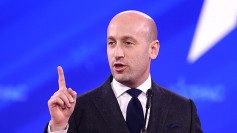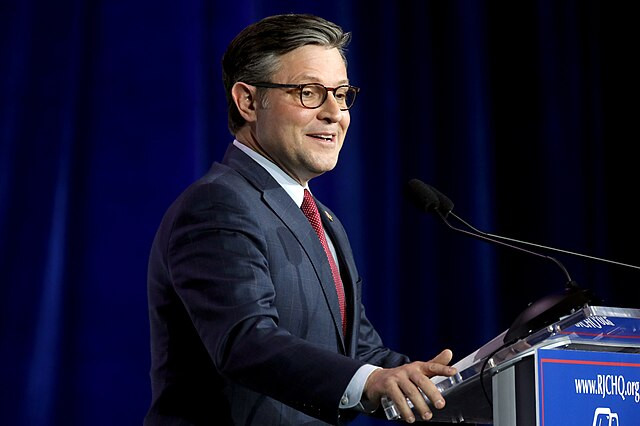
House Speaker Mike Johnson said the Pentagon is seeking $350 billion in additional funding as the United States fights the war with Iran and confronts what he called "communism on our own shores," while acknowledging that lawmakers will receive classified briefings on much of the military request.
The Louisiana Republican said House members were scheduled to hear directly from Defense Secretary Pete Hegseth and his team at the Pentagon on Tuesday evening. The proposed cash infusion, one of the largest additional defense funding requests in U.S. history, would come on top of a $1.15 trillion annual military spending bill and a separate $87 billion supplemental package that includes $67 billion for the Iran war.
"You heard the president talk about how he wants to effectively double the funding for national defence," Johnson told reporters. "Look, we live in dangerous times. We're fighting communism on our own shores, and we're fighting evil terrorists and tyrants around the world, and we have to be able to protect our national security."
The White House's $350 billion request is expected to move through a third Republican reconciliation package, known among GOP lawmakers as Reconciliation 3.0. The budget procedure would allow Republicans to advance legislation in the Senate with a simple majority rather than the 60 votes generally required to overcome a filibuster.
Johnson said the House Budget Committee, led by Texas Republican Jodey Arrington, planned to mark up the legislation on Thursday. The speaker said he had been on the phone with Arrington late Monday night working through the framework but declined to provide a full breakdown of the package before the committee process begins.
The emerging bill is expected to combine the defense funding with other Republican priorities. Those include a grant program intended to encourage states to adopt voter-identification rules associated with President Donald Trump's SAVE America Act and measures targeting what Republicans describe as fraud in federal programs.
Details of the Pentagon request remain limited. Asked to explain how the $350 billion would be spent, Johnson said lawmakers would receive information during the Pentagon briefing, but warned that significant portions wouldn't be available for public discussion.
"Secretary Hegseth and his team will go through and outline a lot of this. Much of that is going to be classified for us," Johnson said.
The Hill has also reported that much of the proposed spending involves classified programs. Neither Johnson nor the White House has publicly provided a detailed account of the military capabilities, operations or procurement programs that would receive the additional money.
The scale of the defense buildup has already generated questions in the Senate. During a hearing on the separate military supplemental, Sen. Tim Kaine, a Virginia Democrat, said the additional requests come "on top of a presidential budget request that increases the Pentagon's budget by 40 percent in one year."
Some Republicans have also raised concerns about elements of the additional spending. Sen. Susan Collins of Maine has questioned parts of the funding push, while Senate Democrats last week blocked the $1.15 trillion defense authorization bill.
Johnson's reference to "communism on our own shores" adds a domestic political dimension to the administration's case for increased military spending. The speaker has used similar language in recent weeks following primary victories by candidates backed by the Democratic Socialists of America in New York.
At a June news conference, Johnson said "the insurgent left is on the rise" and urged Americans to recognize what he described as a growing ideological threat. He has specifically pointed to New York City Mayor Zohran Mamdani as a leading figure in that movement.
The rhetoric comes as the Trump administration faces legal and political disputes over the domestic use of military personnel. President Trump has deployed active-duty Marines to Los Angeles and ordered National Guard units into cities including Portland, Memphis and Chicago, with courts ruling some deployments unlawful.
Trump has also described American cities as possible "training grounds" for the armed forces in confronting what he calls the enemy within. Federal troops are generally restricted from participating in domestic law enforcement, subject to limited legal exceptions including circumstances involving insurrection.