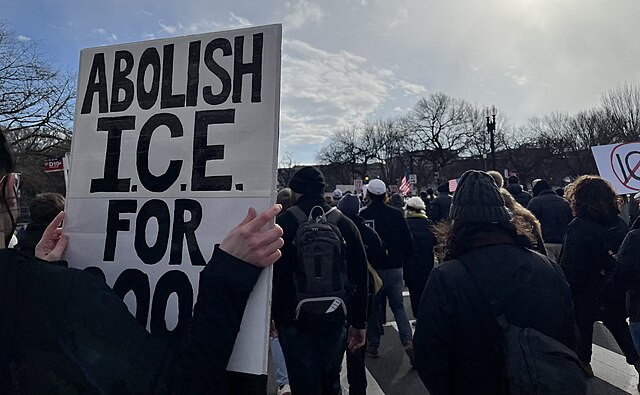
Senior Immigration and Customs Enforcement officials are warning that President Donald Trump's push for as many as 2,000 immigration arrests a day is stretching agents "to the breaking point," creating what one official called a "toxic environment" as four fatal ICE shootings this year intensify scrutiny of the administration's mass-deportation campaign.
The internal criticism, reported by PunchUp, follows two deadly ICE encounters within days of each other in Houston, Texas, and Biddeford, Maine. In both cases, the people killed weren't the original targets of the immigration operations, according to the reports.
A senior ICE official told PunchUp that field offices are once again operating under what agents view as arrest quotas, with managers facing intense pressure to deliver numbers demanded by the Trump administration.
"They are being forced to have quotas again. They are being pushed for numbers and quotas," the official said, describing a "demand for 2,000 arrests a day."
The official said the pressure has affected staffing, leave and field assignments as ICE attempts to increase the pace of arrests. Managers who fail to meet expectations risk losing their positions, the official alleged.
"They are cancelling leave. Stretching the field thin. Pushing them to extremes. It's a very bad, toxic environment. Morale is horrible," the official said.
During one recent operation, the official said, "eighty per cent of the office has to be in the field," including over the July 4 holiday. "It's not sustainable. And it's not safe."
The specific quota figure and allegations involving threats to ICE managers haven't been independently confirmed through agency documents. The Trump administration, the White House and the Department of Homeland Security haven't publicly provided a detailed response to the internal criticism described in the report.
The warnings have gained urgency following the July 7 death of Lorenzo Salgado Araujo, a 52-year-old Mexican immigrant and father who was shot by ICE agents in Houston while driving to work. ICE leadership later acknowledged that Salgado Araujo wasn't the person agents initially intended to arrest.
The Department of Homeland Security initially said Salgado Araujo had "weaponised his vehicle" during the confrontation. None of the ICE agents involved in the shooting was wearing a body camera, according to the report, leaving investigators without body-camera footage of the encounter.
Days later, another immigration operation ended in a fatal shooting roughly 2,000 miles away in Biddeford. A 26-year-old Colombian man identified by a neighbor as Joan Sebastian Guerrero was killed after agents encountered him while reportedly searching for someone else.
Witness accounts said Guerrero was driving when officers approached. Photographs from the scene showed multiple bullet holes concentrated in his windshield. DHS said an officer fired after "fearing for public safety," but the agency has released few additional details about the circumstances surrounding the shooting.
The senior ICE official interviewed by PunchUp said traffic stops have increasingly become a critical enforcement tactic as agents attempt to meet arrest expectations.
"Traffic stops are the only way to get them," the official said. "But every stop, folks are running. Or ramming."
The official argued that agents are being pushed into potentially dangerous vehicle confrontations that could instead be avoided by identifying suspects and attempting arrests later.
"I would shut down ops until we got a handle on [things]," the official said. "Not doing traffic stops. Not blocking the vehicles. If they run. They run. Find them later. Don't force a bad position."
The July shootings follow two earlier fatal ICE encounters in Minnesota involving 37-year-old Renee Good, a mother of three, and 37-year-old intensive-care nurse Alex Pretti. In both cases, early descriptions of the incidents from the Trump administration were later challenged by witnesses and some local officials who questioned whether the government's account matched available evidence.
The four deaths have increased pressure on ICE and DHS to provide more information about field tactics, body-camera use and the operational demands placed on agents. Civil-liberties advocates and community groups have also questioned whether the administration's focus on rapidly increasing arrest totals is encouraging officers to take greater risks during enforcement actions.