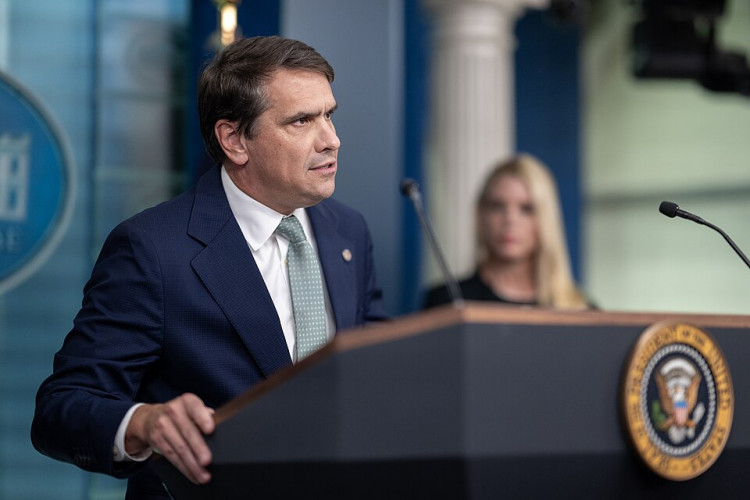
Newly released Justice Department emails place acting U.S. Attorney General Todd Blanche at the center of the Trump administration's "anti-weaponisation" campaign, showing President Donald Trump's former defense lawyer reassigning senior attorneys and overseeing reviews involving some of the president's most prominent legal adversaries.
The documents, obtained through Freedom of Information Act requests by watchdog group American Oversight, surfaced days before Blanche is set to face a Senate hearing over whether he should become Trump's permanent attorney general. More than 1,200 former Justice Department officials have urged the Senate Judiciary Committee to reject his nomination, accusing him of overseeing "corruption and abuses" and damaging the department's nonpartisan career workforce.
The emails complicate the image promoted by Blanche's allies, who have described him as an institutionalist capable of tempering Trump's anger toward investigators and prosecutors who pursued cases against him. The correspondence instead portrays Blanche as directly involved in managing an initiative built around the administration's claim that federal law enforcement had been politically "weaponised."
Blanche's role expanded last year when he served as the top deputy to then-Attorney General Pam Bondi, according to the documents. After Bondi's departure, he continued overseeing the effort and, in May 2025, reassigned senior lawyers from his office to the Justice Department's anti-weaponisation group.
Those assignments gave Blanche's aides responsibility for examining figures closely associated with Trump's legal battles. One lawyer was directed to review special counsel Jack Smith, who prosecuted Trump in cases involving classified documents and the president's efforts to overturn the 2020 election result.
Another aide was assigned to examine Manhattan District Attorney Alvin Bragg, whose office secured Trump's conviction on 34 felony counts stemming from hush-money payments involving adult-film actor Stormy Daniels. A third was directed to review the case of Tina Peters, the former Colorado election clerk convicted after attempting to access voting equipment while pursuing debunked election-fraud claims.
The White House has described the broader anti-weaponisation effort as an attempt to investigate partisan misuse of government power. Critics, including former Justice Department officials, contend that the initiative is targeting investigators, prosecutors and other figures who have come into conflict with Trump.
The leaked correspondence also describes Blanche's involvement in several of the Justice Department's most controversial decisions. According to the documents, he approved the indictment of former FBI Director James Comey after Comey posted an image on social media showing seashells arranged to spell "86 47."
Trump supporters argued that the message referred to removing Trump, the 47th president. Comey denied that interpretation, but Blanche signed off on charges, according to the documents.
The emails further indicate that Blanche endorsed a proposed $1.77 billion taxpayer-funded settlement related to defendants charged over the Jan. 6 attack on the U.S. Capitol. He also supported an agreement that would have provided Trump and his family with broad protections from future tax investigations.
Both proposals later encountered significant legal challenges. The correspondence, however, shows Blanche participating in the decision-making rather than merely reviewing policies developed elsewhere in the department.
Another series of emails concerns Ed Martin, a former Justice Department official assigned to supervise inquiries into the treatment of Jan. 6 defendants and President Joe Biden's use of an autopen to sign documents. Both issues had drawn sustained attention from Trump and his political allies.
Despite Martin's involvement in those administration priorities, Blanche questioned his experience and performance, the emails suggest. Blanche eventually removed Martin from the anti-weaponisation role, though the broader series of reviews involving Trump critics and opponents continued.
The Justice Department hasn't publicly disputed the authenticity of the emails. The documents themselves don't establish that the investigations were launched solely for retaliatory purposes, and several allegations about Blanche's motives haven't been tested in court.
That distinction is likely to become a central issue during Blanche's Senate hearing. His supporters have continued to portray him as a stabilizing influence inside a Justice Department operating under intense political pressure, while his critics argue the newly disclosed correspondence shows him exercising direct control over investigations aligned with Trump's grievances.
The former Justice Department officials opposing Blanche's nomination say the emails reinforce their concerns about the treatment of career personnel and the department's independence. Their letter urges the Senate Judiciary Committee to examine whether political considerations have shaped investigative priorities under Blanche's leadership.