A New York author has filed a federal lawsuit against the Department of Homeland Security, alleging that federal agents retaliated against him for sending a sharply worded email criticizing former acting Immigration and Customs Enforcement Director Todd M. Lyons, raising new questions about the boundary between protected political speech and law enforcement investigations.
David Streever, a Rochester-based writer, filed the 27-page complaint Monday in the U.S. District Court for the District of Columbia with assistance from the Foundation for Individual Rights and Expression (FIRE). The lawsuit names Homeland Security Secretary Markwayne Mullin and several federal agents as defendants, claiming DHS violated Streever's First Amendment rights after agents visited his home and later attempted to locate him at a New York City hotel over an email he sent months earlier.
The dispute centers on an email Streever sent to Lyons on Jan. 26 following the fatal shooting of Minneapolis resident Renee Nicole Good by an ICE officer during an anti-ICE demonstration. According to the complaint, the three-paragraph email carried the subject line "What's next" and compared Lyons to Nazi official Reinhard Heydrich, calling him a "monstrous human being" and stating that he would "never know peace."
Streever has acknowledged writing the message but argues it reflected political outrage rather than any intent to threaten or harm the former ICE official.
"I cherish our right to speak openly about issues of public concern," Streever said in a statement released through FIRE.
FIRE argues the email constitutes constitutionally protected political expression rather than a "true threat," the narrow category of speech that is not protected under the First Amendment.
According to the lawsuit, federal agents did not contact Streever until nearly five months later.
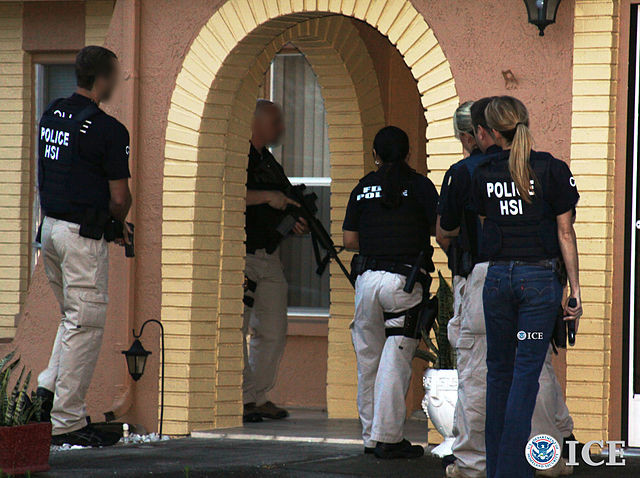
Court filings state that on June 23, two federal agents arrived at Streever's Rochester residence while he was traveling in Finland with his young daughter. His wife informed the agents that he was overseas and expected to return later that week.
Instead of waiting, the lawsuit alleges, the agents left behind a written "Warning Notice" bearing ICE and DHS letterhead stating that Streever "may be in violation of federal law" because of the January email and instructing him to "discontinue" the conduct.
The complaint further alleges that later the same day, while Streever and his daughter were staying at a hotel in New York City, a Homeland Security Investigations agent appeared at the front desk seeking to contact him and left behind a business card. Multiple agents also reportedly left voicemail messages referencing the email, according to court records.
Streever argues those actions were designed to discourage him from criticizing federal immigration authorities in the future.
The lawsuit seeks declaratory relief as well as a court order prohibiting DHS and ICE officials from engaging in what it characterizes as retaliatory conduct against protected speech.
The Department of Homeland Security disputes that characterization.
A DHS spokesperson said the agency "investigates all credible threats towards its employees and officers, including threats to the ICE director," while declining further comment because the matter remains under investigation.
Secretary Mullin's office also rejected the central allegations contained in the lawsuit.
In a statement, the office described claims that DHS was attempting to "squash free speech" as categorically false and added that "anyone who assaults or threatens our law enforcement officers will face the consequences."
The complaint also points to another incident occurring the same day in upstate New York that plaintiffs argue reflects a broader pattern.
According to the lawsuit, federal agents entered a polling place at Syracuse Central Library during New York's primary election to question poll worker Paigelynne Gonyea over an Instagram post concerning the ICE officer involved in Good's fatal shooting.
The lawsuit notes that Gonyea's post called for the officer's indictment. DHS has maintained that the post also included the officer's home address, an allegation Gonyea disputes and that the agency has not publicly substantiated.
The incident has drawn additional scrutiny from elected officials.
A Democratic election commissioner reportedly questioned whether law enforcement had legal authority to enter an active polling location absent an emergency, while Rep. Bennie Thompson, the ranking Democrat on the House Homeland Security Committee, has requested information from ICE regarding the encounter.
The New York Attorney General's Office has also acknowledged that it is reviewing both incidents.