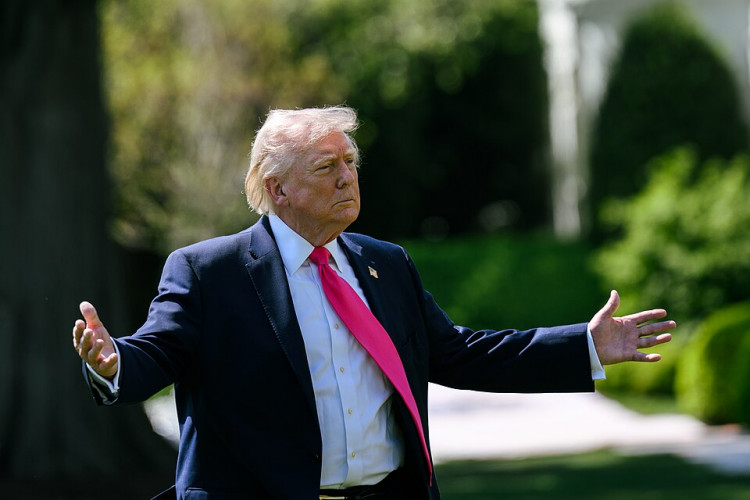
President Donald Trump has again fueled debate over the constitutional limits on presidential tenure after suggesting during the rescheduled White House Correspondents' Dinner that he could run for another term in 2028. The remarks, which echoed comments he has made repeatedly throughout his second term, prompted constitutional scholars to reiterate that the U.S. Constitution bars any individual from being elected president more than twice.
Trump's latest comments came as he joked about another White House campaign before an audience in Washington. Although supporters have often characterized his references to a third term as political humor, legal experts say the issue inevitably draws scrutiny because it touches on one of the Constitution's clearest eligibility requirements.
The president has repeatedly revisited the topic in recent months. During a visit to Michigan, he again alluded to the possibility of serving beyond his current term, while recent posts on Truth Social featured AI-generated images referencing another presidential campaign. Earlier this year, Trump also told NBC News he was "not joking" when asked whether he had considered remaining in office beyond a second elected term.
Those statements have revived discussion over whether any constitutional pathway exists for a president already elected twice to return to office. Most constitutional scholars say the answer remains no.
The central legal barrier is the 22nd Amendment, ratified in 1951 following President Franklin D. Roosevelt's unprecedented four elected terms. The amendment states that "No person shall be elected to the office of the President more than twice," language that legal scholars generally describe as leaving little room for alternative interpretations.
Some Trump allies have suggested hypothetical scenarios that could allow him to return to office without being elected directly. During one television interview, Trump discussed the possibility of Vice President JD Vance winning the presidency before resigning, potentially allowing Trump to succeed him. Former White House strategist Steve Bannon has also publicly discussed constitutional theories involving succession.
Legal scholars, however, have largely dismissed those arguments.
James Sample, a constitutional law professor at Hofstra University, argues that the 12th Amendment closes the most frequently discussed succession theory. Sample notes that the Constitution provides that "no person constitutionally ineligible to the office of President shall be eligible to that of Vice-President," making it unlikely that a twice-elected president could lawfully return through the vice presidency.
Anoo D. Vyas, an assistant professor at the University of Massachusetts, has similarly argued that constitutional term limits should not be minimized regardless of whether political leaders present such discussions seriously or rhetorically. Other constitutional scholars have likewise maintained that any attempt to bypass the 22nd Amendment would almost certainly face immediate legal challenges.
Political scientists, meanwhile, distinguish between the legal question and the political strategy behind Trump's recurring comments. David Schultz, a professor of political science at Hamline University, argues that repeatedly raising the prospect of another campaign keeps Trump at the center of national political discussion even as Republicans begin looking toward the 2028 election cycle.
Other analysts, including Bruce Peabody of Fairleigh Dickinson University and Matthew Beckmann of the University of California, have said the repeated public discussion remains noteworthy because it encourages broader debate about constitutional safeguards and presidential succession, even if the underlying legal theories are widely viewed as implausible.