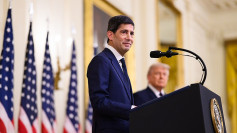
White House chief economist Chris Phelan said he expects no further Federal Reserve interest-rate increases this year, arguing that slowing inflation and September's weak hiring figures undermine the case for additional tightening after last month's quarter-point hike.
His comments put the administration firmly behind a pause as Fed officials weigh a softer labor market against inflation that remains elevated. Policymakers have signaled a willingness to wait for more information, but have not ruled out another increase.
"I think with today's job market data, and a speech by the [Fed] vice chairman, I think the market is now no longer expecting another rate hike," Phelan, chair of the Council of Economic Advisers, told Yahoo Finance on Friday.
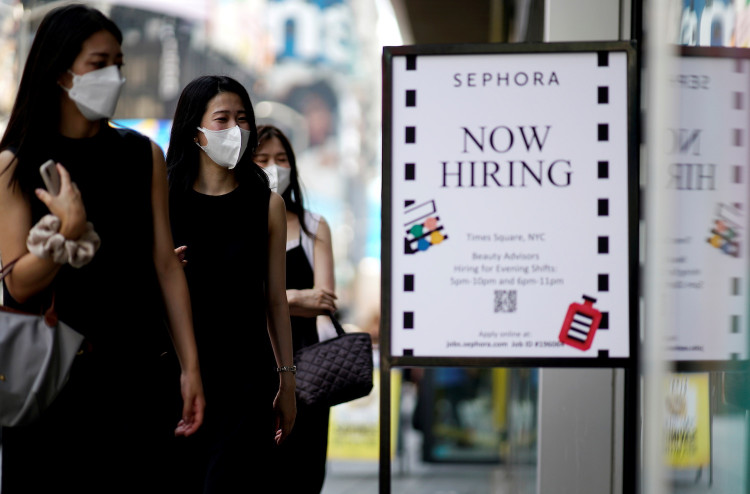
The economy added 29,000 jobs in September, down from a revised 133,000 in August, while unemployment rose to 4.2% from 4.1%, according to the Bureau of Labor Statistics. Revisions also removed a combined 60,000 jobs from July and August's previously reported totals.
July's initial gain of 21,000 became a loss of 10,000, weakening the picture of summer hiring. Job growth has averaged 65,000 a month this year, Yahoo Finance reported.
Phelan nevertheless resisted interpreting the slowdown as evidence of an unhealthy labor market. By his estimate, roughly 40,000 additional jobs a month would keep unemployment stable, and a rate around 4.1% to 4.2% would represent favorable conditions.
"I think the job market's going well," he said. September's hiring fell below his estimated threshold, although the monthly average for the year remained above it.
His stronger criticism concerned the Fed's September decision. Phelan said inflation had already been moderating when officials raised borrowing costs, making the increase unnecessary in his view.
"I said right before they raised rates that it would be a mistake to raise rates. I said right after they raised rates that it was a mistake to raise rates," he told Yahoo Finance.
Phelan cited the Personal Consumption Expenditures price index, the Fed's preferred inflation measure. Its annual increase slowed to 3.4% in August after readings of 3.7% in each of the preceding two months.
Core PCE, which excludes food and energy, eased to 3% from 3.3% in July. Phelan said its three-month annualized pace was about 2%, pointing to the shorter-term measure as evidence that price pressures were already receding before the September rate decision.
"So we are already making progress on inflation," he said. "It's coming down before they took any action."
Fed Vice Chair Philip Jefferson and New York Fed President John Williams have taken a more cautious position. Both acknowledged that inflation remains too high while indicating that officials can assess incoming data before deciding whether further tightening is needed.
Williams said there was "no need for urgency" after September's increase and that "we have time to gather more information." Reuters reported that expectations increasingly favor unchanged rates at the Oct. 27-28 meeting, although another increase later in the year remains possible.