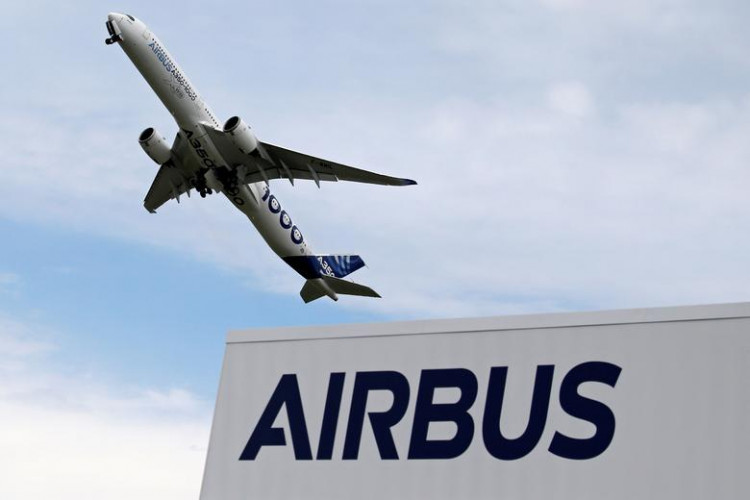
Airbus suffered one of its sharpest market setbacks of the year on Monday as shares fell nearly 10% after the planemaker confirmed a new quality issue affecting fuselage panels on several dozen A320-family aircraft. The disclosure, first reported by Reuters, came as Airbus enters a critical year-end delivery push and faces heightened scrutiny following recent software-related fleet disruptions across global airlines.
The stock drop pushed Airbus to the bottom of the Stoxx 600 in early European trading and marked its steepest one-day decline since June 2024. Investors reacted to uncertainty over how the fresh defect could affect December handovers-an essential period when aircraft manufacturers book significant revenue at delivery.
Industry sources told Reuters the flaw involves defects in fuselage panels installed on multiple A320-series jets. The issue has delayed some handovers as Airbus and its suppliers run additional inspections, though no in-service aircraft have been flagged for immediate safety concerns. Airbus declined to comment directly on the nature or origin of the defect, and the number of customers affected remains unclear.
The timing of the discovery is especially sensitive given Airbus's already demanding 2025 delivery targets. The company delivered 72 aircraft in November, lifting its year-to-date total to 657 jets. Meeting its ambition of about 820 deliveries for 2025 would require more than 160 handovers in December-far above its all-time monthly record of 138 in 2019.
Aviation analysts are divided on whether that pace is realistic. Jefferies aviation analyst Chloe Lemarie recently described November's tally as softer than expected but suggested underlying production still left the goal mathematically possible. Independent aviation analyst Rob Morris said Airbus may approach 800 deliveries, which management could present as "in line" with guidance depending on interpretation, though he noted the final number could still fall "marginally lower" than the stated target.
The fuselage issue follows another major operational challenge. Just days earlier, Airbus completed emergency inspections stemming from a software vulnerability linked to solar flare-induced navigation disruptions affecting approximately 6,000 A320-family jets worldwide. The glitch prompted temporary groundings across North America, Europe, Asia and Australia during one of the busiest periods of the travel year.
In a statement Monday, Airbus said that "the vast majority" of the affected fleet had received required software modifications and that fewer than 100 aircraft were still undergoing updates. The company apologised to airlines and passengers, reiterating that safety remained its top priority and thanking regulators and industry partners for their assistance in implementing the fixes.
Although the fuselage defect is unrelated to the software issue, the cascading timing has rattled investor confidence. The dual setbacks underscore the operational strain on Airbus as global demand for narrow-body jets continues to surge while supply-chain conditions remain fragile. The combination of manufacturing issues and unexpected fleet-wide technical alerts has refocused attention on the company's quality-control practices.
The turbulence spilled into the broader aerospace sector, dragging down suppliers such as Thales, whose shares slipped roughly 3% in early trading. While Thales has no direct exposure to the fuselage defect, analysts said the decline reflected renewed caution about production resilience across the aviation supply chain, which has faced persistent labor shortages, regulatory pressure and component bottlenecks.
With airlines pushing for accelerated deliveries and Airbus racing to close its year-end gap, attention is now centered on whether December's output can offset the latest disruption. Even minor interruptions can significantly affect quarterly earnings due to the heavy concentration of revenue recognition at delivery sign-off. Investors will be watching for updated guidance on fuselage inspections, remediation timelines and any possible shift of aircraft deliveries into early 2026.