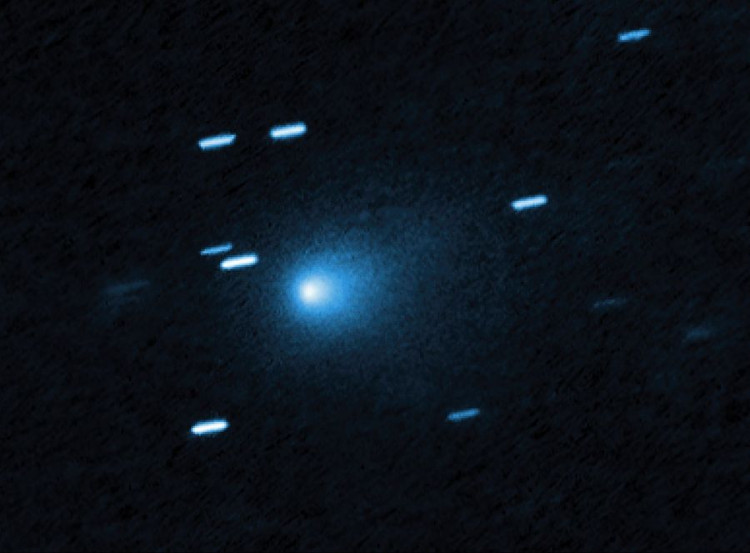
(Photo: NASA, ESA, David Jewitt (UCLA); Image Processing: Joseph DePasquale (STScI))
NASA has formally concluded that 3I/ATLAS, the third confirmed interstellar object ever detected passing through the solar system, is a naturally occurring comet, bringing months of speculation about extraterrestrial technology to a close as the object continues its outbound journey into deep space.
The object was first detected on July 1, 2025, by the Asteroid Terrestrial-impact Last Alert System in Chile and quickly drew attention for its speed, trajectory, and unusual chemical profile. Designated 3I/ATLAS, it followed earlier interstellar visitors 'Oumuamua in 2017 and 2I/Borisov in 2019, intensifying scientific and public interest in objects arriving from beyond the sun's gravitational domain.
NASA's assessment rests on a combination of spectroscopic data, radio observations, and orbital analysis. Measurements from the James Webb Space Telescope showed a carbon-dioxide-to-water-ice ratio higher than that of typical solar-system comets, along with nickel-rich gas signatures, findings consistent with formation in an older planetary system rather than evidence of artificial construction.
A decisive factor came during the comet's closest approach to Earth on Dec. 19, 2025, when researchers affiliated with the Breakthrough Listen initiative directed the Robert C. Byrd Green Bank Telescope in West Virginia toward the object. The search scanned frequencies between 1 and 12 gigahertz, sensitive enough to detect transmissions comparable to a mobile phone.
The result was a complete absence of radio signals. No narrowband emissions, periodic pulses, or other technosignatures were detected. By contrast, the MeerKAT radio array identified hydroxyl emissions, a common byproduct produced when solar radiation breaks down water ice, reinforcing the cometary interpretation.
Even prominent skeptics have acknowledged the weight of the evidence. Harvard astrophysicist Avi Loeb, who previously argued that 'Oumuamua might have been artificial, wrote that 3I/ATLAS is "most likely a comet of natural origin," while maintaining that longer and more comprehensive observation campaigns would be preferable before dismissing all alternative hypotheses.
NASA officials have repeatedly emphasized the absence of any threat. After public speculation spilled into popular culture, including comments from television personalities, then-Acting NASA Administrator Sean Duffy responded directly, stating: "No aliens. No threat to life here on Earth." Nicola Fox, who leads NASA's Science Mission Directorate, echoed that position, saying there is no evidence the object is anything other than a natural comet.
Orbital data show that 3I/ATLAS entered the solar system on a hyperbolic trajectory, reaching speeds exceeding 137,000 miles per hour and peaking near 153,000 mph around perihelion on Oct. 29, 2025. The object passed within roughly 170 million miles of Earth and will not return, as the sun's gravity is insufficient to capture it.
Estimates based on Hubble Space Telescope data place the comet's nucleus between roughly a quarter mile and several miles in diameter, consistent with large, volatile-rich bodies ejected from distant stellar systems. Astronomers believe 3I/ATLAS may have traveled through interstellar space for billions of years before its brief passage through the inner solar system.