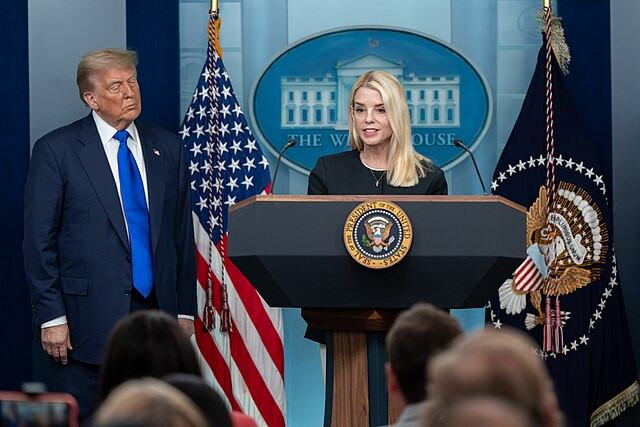
President Donald Trump removed Attorney General Pam Bondi from her post on April 2, praising her publicly as "a true patriot," even as unverified allegations emerged that she may have improperly warned Rep. Eric Swalwell about a potential FBI disclosure tied to his past contact with a suspected Chinese intelligence operative.
The administration has not provided a definitive explanation for Bondi's dismissal, but the timing has drawn attention to internal tensions at the Department of Justice and a renewed push by FBI leadership to revisit politically sensitive intelligence files. Officials familiar with the matter indicate that multiple factors, rather than a single incident, may have contributed to the decision.
At the center of the controversy is a report suggesting Bondi intervened to alert Swalwell about plans to release or review FBI materials related to his prior interactions with Christine Fang, also known as "Fang Fang." The allegation, cited by the Daily Mail and attributed to a senior administration source, has not been substantiated by public evidence.
Swalwell has categorically denied the claim, stating that neither Bondi nor her associates tipped him off. His response sought to shift attention toward internal leaks, suggesting that any information about FBI activity likely reached journalists through official channels rather than external interference.
Acting Attorney General Todd Blanche also rejected the allegation, saying he did not believe it "for a second." Other officials within the administration have indicated that discussions about Bondi's removal predated the emergence of the Swalwell-related claims.
The underlying dispute traces back to late March, when FBI Director Kash Patel reportedly directed agents to reexamine a decade-old file concerning Swalwell's interactions with Fang between 2011 and 2015. The FBI had previously briefed the congressman in 2015, after which he severed contact; the investigation concluded without charges or findings of wrongdoing.
Swalwell's legal team responded to the renewed scrutiny by issuing a cease-and-desist letter to the FBI, arguing that any release of the material would be politically motivated and potentially unlawful. The letter came as Swalwell prepares for a potential 2026 gubernatorial campaign in California, raising the political stakes surrounding the file.
The episode highlights broader concerns within legal and intelligence circles about the handling of sensitive investigative material. The reported effort to review and possibly disclose the file has prompted debate over:
- Privacy protections: Whether releasing intelligence-linked documents could violate federal safeguards.
- Political timing: The proximity to electoral considerations, including Swalwell's anticipated campaign.
- Institutional norms: The extent to which law enforcement actions should remain insulated from political influence.
Bondi's dismissal also reflects a pattern of high-level turnover within Trump's second-term administration, where policy disagreements and internal conflicts have frequently resulted in abrupt leadership changes. Her departure follows other cabinet-level shakeups, underscoring ongoing volatility inside key federal agencies.