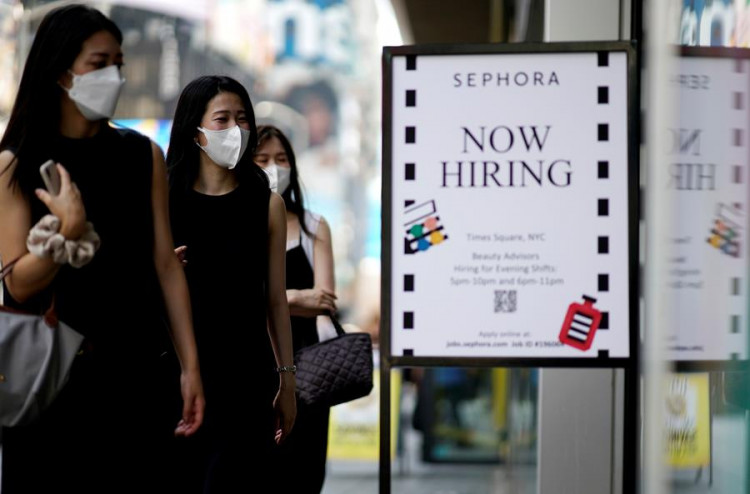
U.S. job openings climbed sharply in April to their highest level in nearly two years, offering fresh evidence that demand for workers remains resilient despite economic uncertainty, even as employers pulled back on actual hiring and workers showed little appetite for changing jobs.
The Labor Department's Job Openings and Labor Turnover Survey, or JOLTS, reported that available positions increased by 731,000 to 7.618 million at the end of April. The figure far exceeded economists' expectations. Reuters reported that economists had forecast 6.88 million openings, making the latest reading one of the strongest labor-market surprises of the year.
The increase arrives at a critical moment for Federal Reserve policymakers, who are weighing whether economic conditions justify lower interest rates. While concerns about inflation, tariffs and global instability have clouded the outlook for much of 2025, the jump in vacancies suggests businesses are still searching for workers at a pace inconsistent with a weakening labor market.
Yet beneath the headline number, the report revealed a more complicated picture.
Hiring fell significantly during the month, indicating that many employers remain reluctant to translate job postings into actual payroll growth. The number of hires declined by 419,000 to 5.116 million, while the hiring rate slipped to 3.2% from 3.5% in March.
Several key labor-market indicators moved in different directions:
-
Job openings increased to 7.618 million.
-
Hiring fell to 5.116 million.
-
The hiring rate declined to 3.2%.
-
Layoffs dropped by 192,000 to 1.692 million.
-
The layoff rate eased to 1.1% from 1.2%.
-
The job openings rate rose to 4.6% from 4.2%.
The divergence between vacancies and hiring highlights a labor market that remains active but cautious. Employers appear willing to advertise positions and explore expansion opportunities, but many are hesitating before making long-term commitments.
Workers are also displaying signs of caution. Economists note that uncertainty surrounding inflation, interest rates, artificial intelligence and global trade conditions may be encouraging employees to remain in existing jobs rather than pursue new opportunities.
The April report follows a period of softer labor-market momentum earlier this year. Concerns about slowing growth had prompted questions about whether businesses would reduce hiring plans as borrowing costs remained elevated. Instead, recent employment figures have shown surprising resilience, with job growth exceeding 100,000 in each of the past two months.
For the Federal Reserve, the data may strengthen the argument for patience. A labor market that continues to generate strong demand for workers reduces pressure on policymakers to move quickly toward lower rates. Reuters reported that financial markets currently expect the Fed to maintain its benchmark interest rate in the 3.50% to 3.75% range into next year while officials continue monitoring inflation trends.