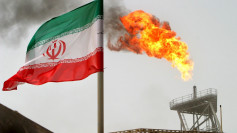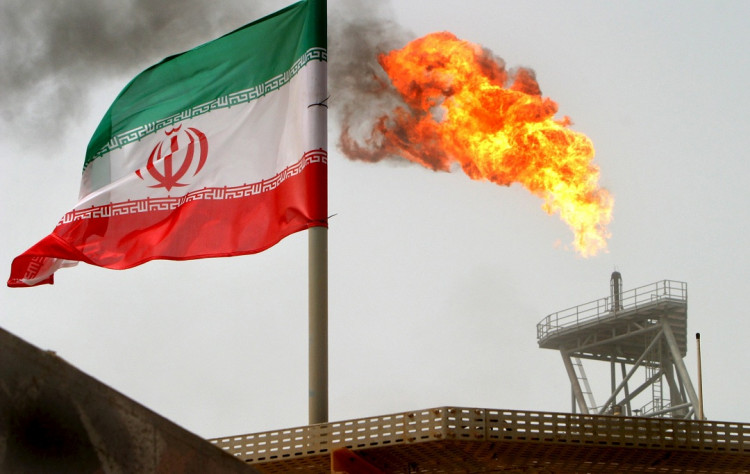
Oil prices fell sharply Monday after the Trump administration authorized temporary Iranian oil sales and negotiators from Washington and Tehran reported progress in Switzerland toward a broader agreement aimed at ending hostilities and reviving diplomatic engagement.
Brent crude, the global benchmark, declined more than 3% to trade below $77.50 a barrel, while West Texas Intermediate fell nearly 3% to around $73.77. The selloff reflected growing expectations that additional Iranian crude could return to global markets and that risks surrounding the Strait of Hormuz, one of the world's most important energy chokepoints, may ease if ongoing negotiations continue to advance.
The market reaction came shortly after Treasury Secretary Scott Bessent announced a temporary policy shift tied to the diplomatic process.
"In line with the ongoing productive talks in Switzerland, Iran has committed to free and open transit in the Strait of Hormuz and to permit International Atomic Energy Agency (IAEA) inspectors into their country. As part of the framework, Treasury has issued a temporary 60-day general license authorizing the production, delivery, and sale of Iranian oil," Bessent said in a social media post.
The authorization represents one of the most significant sanctions-related concessions made by Washington since tensions escalated between the United States and Iran. Investors interpreted the move as a signal that the administration is willing to exchange economic relief for nuclear oversight and regional stability commitments.
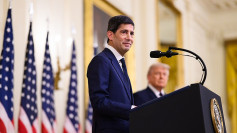
Vice President JD Vance reinforced that message Monday, describing Iran's reported willingness to host inspectors from the International Atomic Energy Agency as a breakthrough.
"It's a major milestone and a first step in permanently ending a nuclear weapons program in Iran," Vance said.
According to Axios, U.S. negotiators entered the Swiss talks seeking precisely that outcome: an invitation for international inspectors to examine key Iranian nuclear facilities. Questions remain, however, regarding the scope of access inspectors will receive, particularly given that several nuclear sites were damaged during U.S. military operations in June 2025.
Diplomatic progress emerged despite a weekend marked by sharp rhetoric. President Donald Trump publicly threatened Iran during a Fox News interview while negotiations were underway.
"You close it and you won't have a country," Trump said, referring to the Strait of Hormuz, according to reporter Trey Yingst.
Yingst further reported that after Iranian President Masoud Pezeshkian defended Tehran's right to continue uranium enrichment activities, Trump responded that he should "better watch his mouth" and "better shape up or we'll take over the rest of the country."
The comments briefly raised concerns that negotiations could collapse before producing tangible results. Iranian officials, speaking through the semi-official Tasnim news agency, said their delegation "has expressed its protest to the American side and is now reviewing an appropriate response to Donald Trump's recent verbal threats."
Behind the public friction, negotiators continued working toward a broader framework agreement. Officials from both countries established a roadmap intended to produce a comprehensive settlement within 60 days.
Among the key developments announced after the talks:
- Creation of a "High Level Committee" to oversee negotiations.
- Establishment of working groups focused on implementation and dispute resolution.
- Formation of a deconfliction mechanism addressing continued violence in Lebanon.
- Commitments to continue discussions throughout the week.
Pakistan and Qatar, which have played mediating roles in the discussions, described the talks as "positive" and "constructive."
Vance acknowledged that tensions nearly disrupted the process but argued both sides ultimately prioritized negotiations over confrontation.
"We told the Iranians yesterday. 'When you guys engage in what we millennials call trash talk, you can't expect the president of the U.S. not to respond and not to correct the record,'" Vance said.
"So yes, there was a little bit of threatening and a little bit of whining but at the end of the day the talks continued and we made great progress," he added.
The decline in oil prices highlights how closely energy markets are tracking developments in the U.S.-Iran relationship. For traders, the combination of potential Iranian exports returning to market, commitments regarding the Strait of Hormuz, and the prospect of reduced military tensions has begun outweighing fears generated by the heated exchanges between Washington and Tehran.
With negotiators now operating under a 60-day timetable and Treasury temporarily reopening a pathway for Iranian oil sales, investors are increasingly treating diplomacy-not military escalation-as the primary driver of oil-market sentiment.