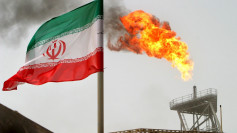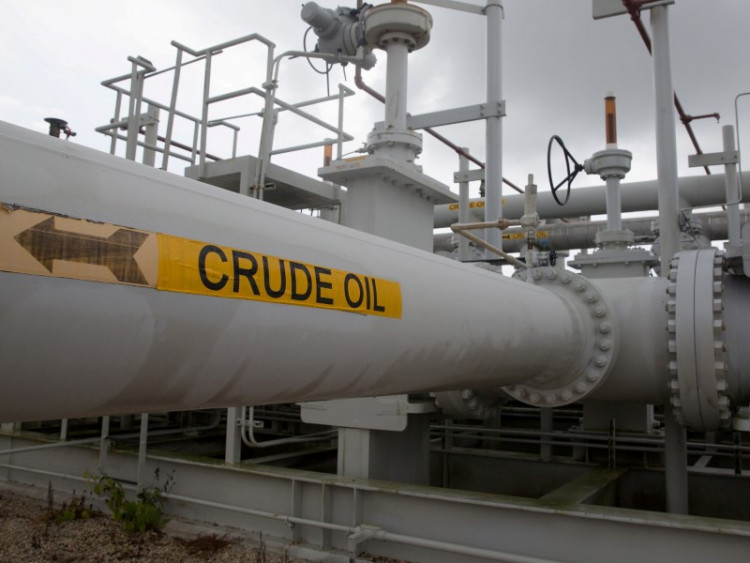
Oil prices moved higher Monday after renewed military tensions in the Strait of Hormuz reminded traders how quickly geopolitical risks can disrupt one of the world's most important energy corridors, even as the United States and Iran agreed to suspend further strikes ahead of another round of diplomacy.
Benchmark crude futures gained after several days of military exchanges threatened a fragile ceasefire reached earlier this month. Investors largely viewed the latest agreement to halt attacks as a step toward de-escalation, but uncertainty surrounding shipping security and conflicting signals over upcoming negotiations continued to support oil prices.
By 8:37 a.m. ET, Brent crude, the international benchmark, had risen 0.80% to $73.19 a barrel. West Texas Intermediate, the U.S. benchmark, climbed 1.13%, pushing back above the psychologically important $70-a-barrel level.
The price gains followed a weekend in which Washington and Tehran announced they would suspend military operations around the Strait of Hormuz after several days of retaliatory attacks.
According to Axios, officials from both countries concluded that the latest confrontation resulted from differing interpretations of the memorandum of understanding that ended the recent conflict, particularly provisions governing commercial navigation through the narrow waterway.
The latest escalation began after President Donald Trump accused Iran on Friday of violating the ceasefire.
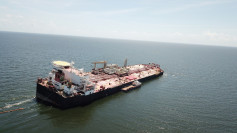
Trump said the Iranian military fired "at least four One Way Attack Drones at Ships transversing the Strait of Hormuz," alleging that one drone struck the upper deck of a commercial cargo ship while three others were intercepted.
The United States subsequently carried out retaliatory strikes against Iranian military targets on at least two separate occasions, according to the information provided.
Although both governments later agreed to halt attacks, the latest confrontation reinforced concerns over the security of the Strait of Hormuz, through which roughly one-fifth of global seaborne oil supplies normally pass. Any disruption to shipping through the corridor has historically triggered volatility across global energy markets.
At the center of the dispute is Iran's effort to exert greater authority over maritime traffic through the waterway.
According to The Wall Street Journal, Iranian officials have been promoting a proposal that would allow Tehran to oversee shipping movements and collect transit-related fees. Iranian officials familiar with the discussions told the newspaper the plan could generate approximately $40 billion annually if fully implemented, creating an entirely new revenue source for the country.
The Wall Street Journal also reported that Tehran has presented the proposal to neighboring Gulf countries, arguing that sharing revenue with regional partners could make the initiative more attractive while expanding support for the framework.
The military pause has shifted attention toward diplomacy, but mixed messages continue to cloud expectations for upcoming negotiations.
"We decided to stop all the kinetic activity," a senior U.S. official told Axios after Washington and Tehran reached Sunday's agreement to suspend further strikes ahead of planned discussions in Qatar.
However, uncertainty emerged Monday over whether those talks will proceed as expected.
Iranian President Masoud Pezeshkian announced that Qatar would release $6 billion in frozen Iranian assets, describing the broader understanding with Washington as "a great victory for the Iranian people."
Those claims were immediately disputed.
According to The Associated Press, U.S. officials said no frozen Iranian assets had been released, while Qatar had not publicly acknowledged any transfer of Iranian funds.
Confusion also surrounded the diplomatic calendar.
Several reports indicated that negotiations between U.S. and Iranian representatives would resume Tuesday in Doha. Yet senior Iranian negotiator Kazem Gharibabadi challenged those reports.
"Although consultations with Qatar, including on following up on the implementation of the other side's commitments, are continuing as usual, reports by some media about technical talks by the working groups being held in Doha are not confirmed," Gharibabadi said.