Global oil prices surged and stock futures weakened Wednesday after President Donald Trump declared that the ceasefire with Iran was effectively over, signaling a sharp escalation in tensions following renewed attacks in the Strait of Hormuz. The remarks came hours after U.S. forces launched a broad military operation targeting Iranian military assets, raising fresh concerns about energy supplies moving through one of the world's most critical shipping lanes.
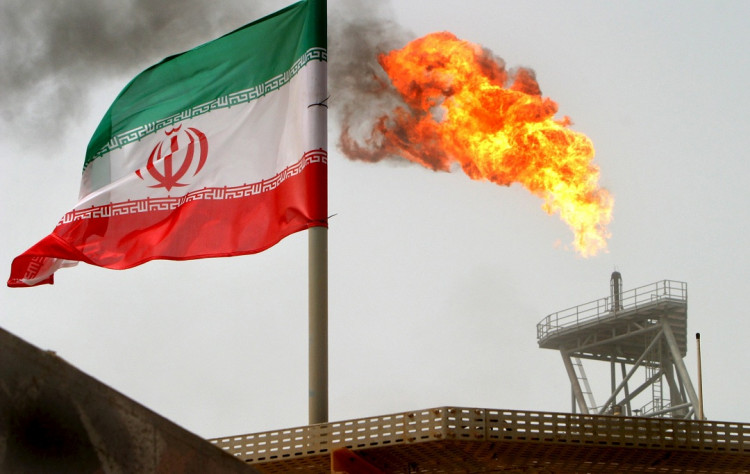
Brent crude, the international benchmark, climbed more than 5% to trade above $78 a barrel in early U.S. trading, while West Texas Intermediate rose nearly 5% to about $73.94 per barrel. The advance reflected growing fears that renewed military action around the Strait of Hormuz could disrupt global oil exports, sending investors toward energy assets while broader equity markets moved lower.
Speaking to reporters while attending the NATO summit in Turkey, Trump suggested he no longer viewed diplomacy with Tehran as productive after the latest exchange of military strikes.
"I think it's over. I don't want to deal with them anymore," Trump said.
The president delivered some of his strongest criticism yet of Iran's leadership, accusing its government of acting in bad faith while leaving open the possibility that negotiations could technically continue.
"They can talk, but I think they're wasting their time. They're a bunch of lying guys," Trump said.
He also described Iran's leaders as "scum," adding, "They're sick people. They're led by people, and they're vicious, violent people," and argued that "they'd use it" if Tehran ever obtained a nuclear weapon.
The latest deterioration follows a series of attacks on commercial shipping transiting the Strait of Hormuz, one of the world's most strategically important maritime corridors for crude oil exports. According to U.S. Central Command, American forces responded by conducting a large-scale operation against Iranian military infrastructure.
CENTCOM said U.S. forces struck "over 80 targets with precision munitions as an immediate response to Iran's latest attacks on commercial vessels transiting the Strait of Hormuz."
According to the military, the operation targeted "Iranian air defense systems, command and control networks, coastal radar sites, anti-ship missile capabilities, and more than 60 Islamic Revolutionary Guard Corps small boats in and near the strait to degrade Iran's ability to continue attacking international commerce flowing through the international trade corridor."
Trump later described the operation as a decisive response to Iran's actions following ceremonies honoring the late Supreme Leader Ali Khamenei.
"They're sick. There's something wrong with them. We say go and do your funeral stuff, and instead of that, they start shooting rockets at ships yesterday, and so we hit them very hard last night, very hard. I would say 20 to 120 times tougher," Trump told reporters.
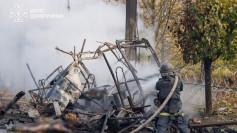
Regional tensions widened further after Iran launched strikes against Kuwait and Bahrain, prompting Egypt, Qatar, Jordan and Kuwait to issue statements condemning the attacks as "a flagrant violation of the sovereignty." The latest exchanges have heightened concerns that the conflict could spread beyond Iran and the Strait of Hormuz into a broader regional confrontation.
The military escalation also received backing from NATO leadership. Following his meeting with Trump, NATO Secretary General Mark Rutte described the U.S. military operation as "absolutely necessary," signaling continued support from key Western allies despite the rapidly deteriorating security situation.
Alongside the military response, Washington also increased economic pressure on Tehran by revoking a temporary sanctions waiver that had allowed limited Iranian oil sales. The waiver had been granted only weeks earlier as part of a broader diplomatic memorandum intended to facilitate negotiations over Iran's nuclear program.