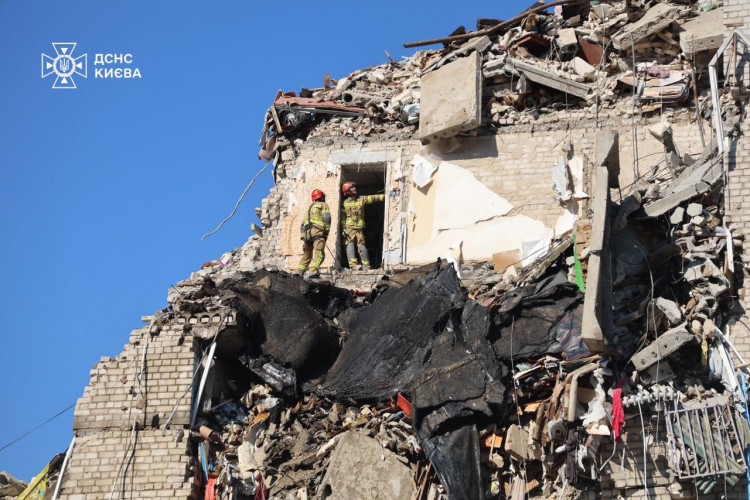
Russia launched its largest aerial assault of 2026 against Ukraine, firing 74 missiles and nearly 500 drones in a barrage that killed at least 18 people, wounded dozens more and prompted President Volodymyr Zelensky to cut short an overseas trip as Kyiv renewed urgent appeals for additional Western air-defense systems.
According to the Ukrainian Air Force, the overnight attack targeted multiple regions but was concentrated on the capital, Kyiv, where residential buildings were among the sites struck. Ukrainian officials said the scale of the barrage and a lower-than-usual interception rate allowed more projectiles to reach their targets, resulting in one of the year's deadliest attacks.
The escalation came as the war entered another grim phase, with fighting intensifying both inside Ukraine and deep within Russian-held territory. While Moscow portrayed the strikes as retaliation for Ukraine's expanding drone campaign against Russian infrastructure, Kyiv argued the latest bombardment underscored the need for more advanced defensive weapons from its allies.
Zelensky interrupted a visit to Ireland to return home following the attacks. In remarks after arriving back in Ukraine, he said Russia's primary objective had been Kyiv and reiterated that strengthening Ukraine's air-defense network remained an "absolute and critical priority."
The latest assault follows weeks of increasingly frequent Ukrainian drone strikes inside Russia and occupied Crimea. Ukrainian attacks have focused heavily on energy infrastructure, logistics facilities and military assets, creating supply disruptions that Russian officials have publicly acknowledged.
President Vladimir Putin recently admitted that Ukrainian operations had caused shortages in some regions. Authorities in occupied Crimea have also introduced emergency measures after repeated attacks disrupted infrastructure across the peninsula.
Last week, Crimea's Moscow-installed leadership declared a state of emergency. Regional head Sergei Aksyonov said on Telegram that the measure would allow officials to respond more quickly to stabilize the situation, although authorities provided few operational details.
Officials have already implemented several restrictions across the peninsula, including suspending civilian gas sales indefinitely. Aksyonov said the supplies were needed to "ensure the functioning and security of the Republic of Crimea."
In Sevastopol, authorities announced additional emergency measures that include ending public transportation after 10 p.m., requiring large shops and cafés to close earlier than usual and reducing street lighting during parts of the day in an effort to conserve resources and improve security.
Despite those disruptions, Putin insisted Ukrainian attacks have failed to alter Russia's military position.
"Strikes on our infrastructure, wherever they are directed, have absolutely no effect on the situation at the front, on the line of contact," Putin said.
He also argued that Kyiv was attempting to "cause a split in Russian society and force Russia to halt, even if only briefly, the advance of our troops along the line of contact, and create conditions for launching a negotiation process on terms advantageous to our adversary."
Putin further claimed Ukraine had proposed halting long-range strikes inside Russia while limiting active combat to the four partially occupied regions of Donetsk, Luhansk, Kherson and Zaporizhzhia. According to Putin, Moscow rejected the proposal because it would have enabled Ukraine to reposition forces into those territories. Ukrainian authorities have not publicly confirmed that such an offer was made.
The renewed escalation coincided with new estimates highlighting the enormous human cost of the conflict. Citing a new study reported by CNN, researchers Seth G. Jones and Riley McCabe estimated that Russian casualties have surpassed 1.4 million since the invasion began, including roughly 450,000 fatalities.
"Russian fatalities in Ukraine are more than four times greater than all US fatalities in all wars combined since World War II, and more than nine times greater than all Soviet and Russian fatalities in all wars combined since World War II," Jones and McCabe wrote.
The study also estimated that Ukraine has suffered more than 500,000 casualties during the conflict, illustrating the extraordinary losses sustained by both sides after more than four years of war. While casualty estimates vary among governments and independent researchers, analysts broadly agree that the conflict has become one of Europe's deadliest wars since World War II.