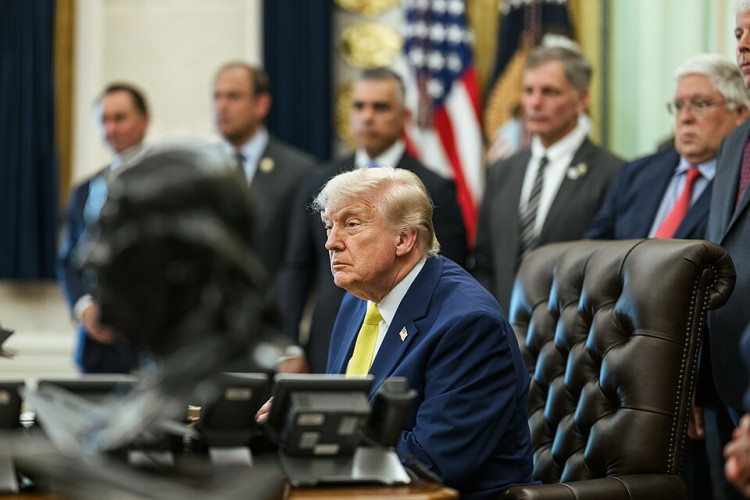
President Donald Trump warned Republican lawmakers that losing control of the House of Representatives in the 2026 midterm elections could pave the way for a third impeachment effort, reviving one of the defining political battles of his first presidency while urging his party to protect its narrow congressional majority.
Speaking before a gathering of Republican lawmakers, Trump argued that Democratic control of the House would inevitably lead to new impeachment proceedings, regardless of the underlying allegations. His remarks tied the stakes of the upcoming midterms directly to the future of his presidency.
"You gotta win the midterms, because if we don't win the midterms, it's just going to be, I mean, they'll find a reason to impeach me," Trump told the audience.
The president also reflected on his two previous impeachments, maintaining they lacked merit.
"They impeached me. I never knew I was going to be impeached. I get a phone call, 'You just got impeached.' I said, 'What does that mean?'" Trump said.
Trump remains the only U.S. president to have been impeached twice. In both instances, the House approved articles of impeachment, but the Senate acquitted him, allowing him to remain in office.
His first impeachment unfolded in December 2019 after the Democratic-controlled House accused him of abusing presidential power and obstructing Congress. The proceedings centered on allegations that Trump pressured Ukraine to investigate then-presidential candidate Joe Biden and his son, Hunter Biden, while U.S. military assistance to Kyiv was temporarily withheld.
Trump consistently denied wrongdoing and argued the impeachment represented an effort to overturn the outcome of the 2016 election. In February 2020, the Republican-controlled Senate acquitted him on both articles.
A second impeachment followed in January 2021 after the attack on the U.S. Capitol, where lawmakers charged Trump with incitement of insurrection following the events of Jan. 6 as Congress met to certify Biden's 2020 election victory.
House Democrats argued Trump's conduct surrounding the election and his remarks before the Capitol attack contributed to the violence. Trump rejected the accusation and maintained his speech was protected under the First Amendment.
Although 57 senators voted to convict Trump during the Senate trial, the total fell short of the two-thirds majority required for conviction, resulting in a second acquittal.
Trump's two impeachment proceedings included:
- December 2019: House impeached Trump on charges of abuse of power and obstruction of Congress related to Ukraine.
- February 2020: Senate acquitted Trump.
- January 2021: House impeached Trump for incitement of insurrection following the Jan. 6 Capitol attack.
- February 2021: Senate again acquitted Trump after conviction votes failed to reach the constitutional threshold.
Trump's latest warning comes as Republicans prepare to defend a narrow House majority in the 2026 elections. Even a relatively small shift in seats could return control of the chamber to Democrats, giving them authority to launch investigations, issue subpoenas and consider articles of impeachment.
While no formal impeachment resolution targeting Trump's second term has been introduced, some Democrats have suggested additional congressional scrutiny could follow if their party regains control of the House.
Rep. Ro Khanna, a Democrat from California, has previously said another impeachment could be considered if Democrats conclude Trump's actions during his second term warrant such proceedings.