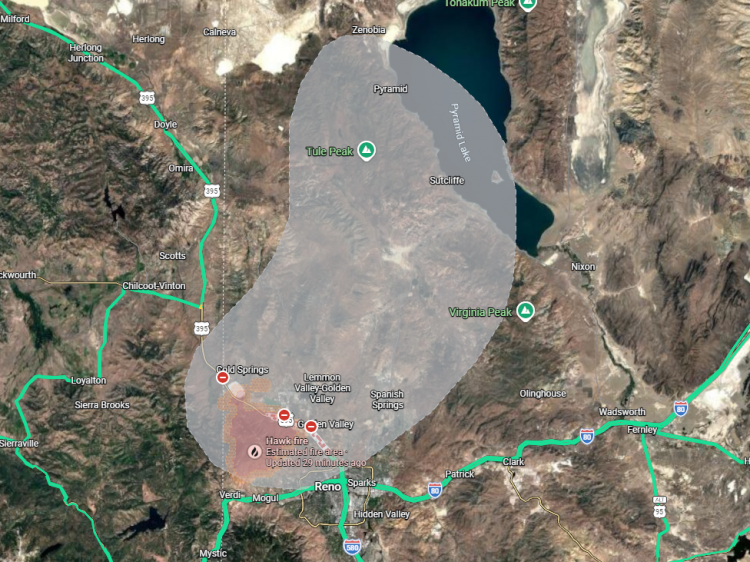
The human-caused Hawk Fire expanded to roughly 13,000 acres near Reno, Nev., injuring six people and putting about 90,000 residents under evacuation orders or warnings as shifting winds drove flames toward populated neighborhoods and Gov. Joe Lombardo declared a state of emergency in Washoe County.
The wildfire started Saturday afternoon around Peavine Peak in the Humboldt-Toiyabe National Forest and spread rapidly through dry brush and rugged terrain. Authorities reported zero containment as firefighters confronted changing winds that repeatedly altered the direction of the blaze.
About 42,000 residents were placed under mandatory "GO NOW" evacuation orders, while roughly 45,000 others were in warning zones and encouraged to leave before roads became congested. The evacuation perimeter expanded toward the University of Nevada, Reno, as authorities closed portions of U.S. Route 395.
Washoe County Sheriff Darin Balaam said unpredictable mountain winds created hazardous conditions for both residents and emergency personnel, at times allowing flames to move around firefighting equipment and interfere with crews trying to reach threatened areas.
"It was extremely confusing," Balaam said, describing the shifting winds and rapidly changing fire behavior.
Lombardo declared an emergency Sunday, allowing Nevada to deploy additional state resources as approximately 800 firefighters worked to slow the fire. The Nevada National Guard was mobilized to assist the operation, including two helicopter crews conducting aerial water drops.
Another 60 Guard personnel were assigned to help law-enforcement agencies secure evacuated communities. Officials were particularly concerned about protecting empty homes while firefighters concentrated resources along the fire's advancing perimeter.
"This is an active and rapidly evolving situation, and I urge everyone in the affected areas to remain vigilant," Lombardo said in a public statement.
Unified incident commander Shane Akerson said three civilians and three first responders had been injured. Authorities were still conducting damage assessments in foothill communities, and a complete count of destroyed or damaged structures wasn't immediately available.
The rapid evacuation effort created substantial disruption around Reno, a city of more than 280,000 residents and Nevada's largest population center outside the Las Vegas area. The Reno-Sparks Convention Center was converted into an evacuation facility for displaced residents, while separate arrangements were established for animals because pets weren't permitted in the center's main hall.
Some downtown Reno casino operators also offered discounted hotel rooms to residents forced from their homes. The combination of evacuation orders, highway closures and tens of thousands of displaced residents placed additional pressure on transportation routes as officials urged people in warning areas not to wait until conditions deteriorated.
Resident Tyler Duvall said the speed at which the fire escalated caught some people by surprise. After returning from a weekend camping trip, Duvall found his neighborhood cordoned off and said homes about a mile from his property had already been destroyed.
The blaze had initially appeared relatively manageable before strong canyon winds accelerated its growth, according to Duvall's account. That pattern underscores one of the principal challenges facing firefighters: dry vegetation combined with terrain-driven winds can cause the fire front to change speed and direction quickly.
Utility disruptions also spread with the fire. About 60,000 customers initially lost electricity Saturday, though crews had reduced the number without power to roughly 5,000 by Sunday afternoon.
Across the state line, California Gov. Gavin Newsom said emergency officials were monitoring the wildfire near the Nevada-California border and were prepared to assist local authorities. The regional response comes as fire crews contend with weather conditions favorable to further spread.