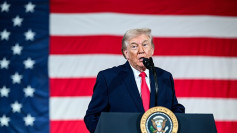
President Donald Trump must answer questions under oath by December 11 in his $10 billion lawsuit against the BBC, a federal magistrate judge ruled Thursday after the broadcaster accused him of delaying a deposition he canceled earlier this month.
U.S. Magistrate Judge Enjoliqué A. Lett also warned at the Miami hearing that the case could be dismissed if Trump's lawyers fail to provide documents the BBC is entitled to obtain for its defense. No dismissal was ordered.
The ruling puts Trump's testimony ahead of the December 18 discovery deadline, rather than the January window his lawyers requested. Lett said the deposition date could move if the evidence-gathering period is extended.
"Engaging in discovery is burdensome, but is a burden we undertake, especially if we file a lawsuit," Lett said, according to CNN.
BBC attorney Charles Tobin told the court that "we still haven't been able to depose" Trump, with roughly two months remaining to complete discovery. The trial is provisionally set to begin February 15, 2027, in Miami and last two weeks.
Trump had agreed to an October 16 deposition before his lawyers canceled it, citing "matters of national importance." They subsequently pointed to the Iran and Ukraine wars and the White House Accord on Super Intelligence among the demands on his schedule.
The BBC challenged that explanation, saying Trump traveled to Georgia for a campaign rally and then attended a Republican National Committee fundraiser at Mar-a-Lago. According to the daily schedule cited by Axios, he also had an intelligence briefing and executive time before leaving Washington.
Trump's lawyers denied that he was avoiding testimony. In Wednesday's filing, they offered dates between January 11 and January 22, after the existing discovery deadline, arguing that his presidential responsibilities prevented an earlier appearance.
The lawsuit concerns the Panorama documentary "Trump: A Second Chance?," broadcast October 28, 2024. Trump alleges that the BBC's editing of his January 6, 2021, speech falsely portrayed him as encouraging violence at the Capitol.
The program joined excerpts from different parts of the speech into what appeared to be a continuous passage. Trump seeks $5 billion for defamation and another $5 billion under Florida's unfair and deceptive trade practices law.
The BBC apologized in November 2025, acknowledging that the edit created "the mistaken impression that President Trump made a direct call for violent action." It denies defamation and has moved to dismiss the case.
Among its arguments, the broadcaster says the documentary does not satisfy the legal requirements for defamation and was not available in the United States, according to Variety. Trump's legal team maintains that the editing was deliberate and intended to influence the 2024 election.
In July, Trump dropped claims against BBC Studios Distribution and BBC Studios Production after the broadcaster argued that neither commercial entity had a role in making the documentary. His case against the BBC continues.
The controversy preceded the November 9, 2025, resignations of director-general Tim Davie and BBC News chief Deborah Turness. Davie acknowledged mistakes and accepted ultimate responsibility, while Turness said the dispute was damaging the broadcaster and rejected allegations of institutional bias.