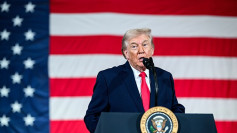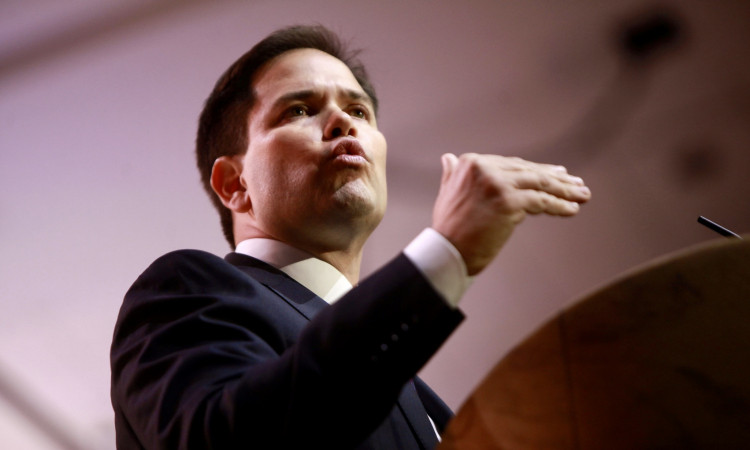
Secretary of State Marco Rubio has told U.S. allies that Washington isn't expected to launch new military strikes against Iran "for the time being," as President Donald Trump's administration shifts its immediate focus toward tightening economic pressure on Tehran, according to Axios.
Rubio told foreign counterparts that a return to major combat operations isn't currently under consideration, a U.S. official familiar with the discussions told Axios. The administration hasn't ruled out future military action, however, particularly if Iran initiates another attack.
The message signals a change in emphasis following the recent military confrontation and comes as Washington says a major source of tension in the Strait of Hormuz has been removed. Trump announced that U.S. forces had cleared mines from international waters in the strategically critical shipping route.
"I have just been informed by the United States Navy that all mines have been removed and/or detonated from within the International Waters of the Strait of Hormuz," Trump said in a social-media post.
Trump paired the announcement with a warning that Washington would respond immediately if Iran resumed mine-laying operations. "Iran has been notified that any ship or boat placing new mines will be immediately and systematically destroyed. Through Space Force, we are watching every square inch of the Strait, as we are, also, with Pickaxe Mountain and the already destroyed three other Nuclear sites. There is a Zero Tolerance policy on mine placement in full force and effect," he added.
One source cited by Axios described the removal of the mines as an important moment because it eliminates a significant point of leverage surrounding the waterway. The Strait of Hormuz is a crucial artery for global energy shipments, making disruptions there capable of quickly affecting oil markets and the wider global economy.
Rather than immediately returning to military action, the administration is now escalating its campaign against Iran's economic networks. Treasury Secretary Scott Bessent this week unveiled what the government is calling "Operation Economic Outcast," an effort centered on secondary sanctions against businesses and financial institutions that enable Iranian economic activity.
The approach could put Washington on a collision course with companies and financial institutions outside Iran, including potentially in China. Asked whether Chinese banks could be targeted or spared to avoid damaging relations with Beijing, Bessent said enforcement wouldn't stop at geopolitical boundaries.
"We want to make clear here today that no one is above the reach of U.S. sanctions," Bessent said.
"If they facilitate transactions and are part of the ecosystem that turns Iranian oil into money, into repression, they will be targeted," he added.
The possibility of sanctions affecting Chinese institutions introduces another complication ahead of a planned September meeting between Trump and Chinese President Xi Jinping. Any enforcement action against major Chinese banks or businesses could broaden the Iran dispute into Washington's already complex economic relationship with Beijing.
The strategy reflects an effort to pressure Tehran financially while keeping military options available. Secondary sanctions can extend beyond Iranian entities themselves by threatening foreign institutions with penalties or restrictions if they continue facilitating transactions connected to sanctioned Iranian activities.
Signs that Iran's economic difficulties are becoming a political concern have emerged publicly from senior officials in Tehran. Iranian parliament speaker Mohammad Bagher Qalibaf acknowledged last week that military strength by itself wouldn't provide the country with lasting security or stability.
"No matter how much military power we have, if people are hungry and we don't have financial circulation, economic growth and domestic production, we will not endure," Qalibaf said during a meeting with Iranian and Iraqi business leaders at the Iranian embassy in Baghdad.
Qalibaf argued that national security ultimately depends on maintaining a functioning economy. "If we establish security but do not sustain it through the economy, it will not last," he said, while accusing the U.S. and Israel of conducting what he characterized as "cognitive" warfare.