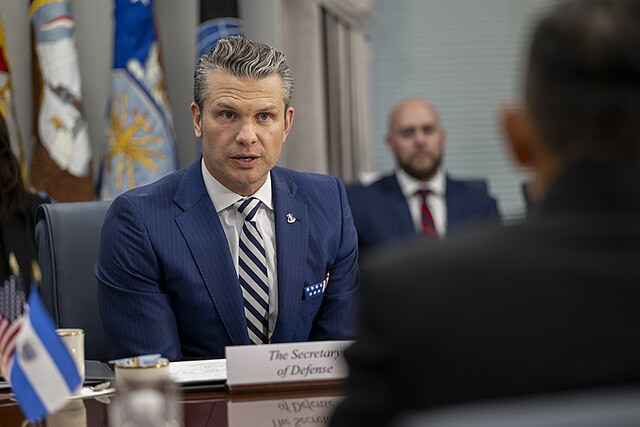
Senior U.S. military commanders have warned Defense Secretary Pete Hegseth that keeping American forces and equipment committed to the Iran conflict for an extended period risks weakening the military's ability to respond to threats elsewhere, according to The Washington Post, as separate intelligence assessments indicate Russia believes Washington's resources are increasingly stretched.
The warnings were contained in an assessment incorporating input from senior commanders responsible for operations in Europe, Asia and Latin America. Some military leaders formally registered their disagreement with plans to keep forces in the Middle East longer while acknowledging that they would carry out the orders, according to the report.
One person familiar with the assessment described the Iran commitment as "too much for too long."
The concerns appear in the Secretary of Defense Orders Book, or SDOB, which The Washington Post described as a document tracking the availability and deployment of American troops and military equipment around the world while incorporating assessments from top commanders.
The document provides Hegseth and other senior officials with a picture of how commitments in one theater affect the military's capacity elsewhere. That calculation has become increasingly difficult as operations involving Iran consume personnel, weapons and equipment that would otherwise be positioned for other regional missions.
Some commanders responded to orders extending Middle East deployments with a "non-concur," according to The Washington Post. Such a designation records disagreement with a decision without amounting to a refusal to execute the order.
The concern isn't simply that the Iran operation requires substantial resources. Commanders have reportedly warned that diverting units and equipment from their normal assignments could undermine their ability to carry out other responsibilities, including homeland-defense missions.
Sean Parnell, a spokesman for Hegseth, defended the Pentagon's decision-making process and said force deployments are determined by changing security conditions rather than fixed regional allocations.
"Decisions regarding the scope and duration of specific force commitments to any Combatant Command are made based on the current threat assessment, strategic priorities established by the President, and the advice of the Chairman of the Joint Chiefs of Staff and Combatant Commanders," Parnell told The Washington Post.
The internal warnings come as another U.S. intelligence assessment suggests America's rivals are reaching their own conclusions about the strain created by the Iran conflict. Russia believes the prolonged U.S. commitment has weakened Washington's ability to respond to additional crises, according to classified intelligence cited by The Washington Post last week.
Those assessments reportedly describe significant pressure on U.S. stocks of equipment and ammunition following sustained operations against Tehran, particularly around the Strait of Hormuz. Among the weapons cited as severely depleted are Tomahawk cruise missiles and the Army Tactical Missile System, or ATACMS.
Both systems have potential roles well beyond the Middle East. Tomahawks provide the U.S. with a long-range conventional strike capability, while ATACMS has figured prominently in planning and operations connected to other theaters, making replenishment rates increasingly relevant to America's broader military posture.
The reported shortages add another dimension to the Pentagon's force-management problem. The military must simultaneously sustain operations involving Iran, maintain deterrence in Europe as Russia continues its war against Ukraine, preserve forces for potential contingencies in the Indo-Pacific and meet homeland-defense requirements.
Russia appears to be monitoring those pressures closely. One person familiar with the U.S. intelligence assessment said Moscow's perception of American military depletion helped explain CIA Director John Ratcliffe's unannounced trip to Russia last week.
The visit was "less about Putin being in a corner" because Russian forces haven't achieved major gains in Ukraine and "more because Russia assesses we are depleted and can't intervene," the person said.