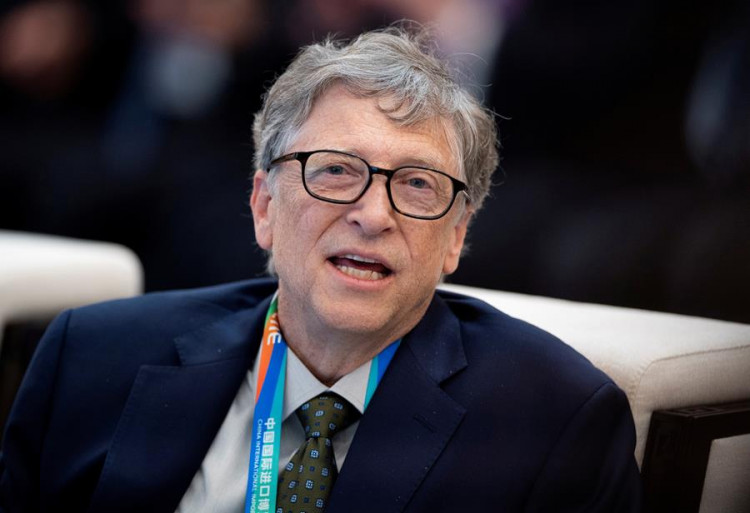
Bill Gates is warning that artificial-intelligence companion apps could insulate children from the social friction and intellectual challenges they need to develop, comparing an AI-protected childhood to growing up inside a "big, protected greenhouse" as schools and families grapple with rapidly improving technology.
In a roughly 6,000-word essay published this week, the Microsoft co-founder identified risks that extend well beyond education. Gates focused on three broad concerns surrounding the AI transition: permanent job displacement, the technology's potential use by bad actors and long-term changes in how children learn and develop.
His concern isn't that children are using AI itself. Gates instead draws a line between technology that helps students understand difficult material and systems that become a "crutch," allowing users to bypass the intellectual work that produces learning.
AI could tutor a teenager struggling with calculus, for example, but Gates warned that the same technology "could also lead to many people learning less." The challenge for educators, he argued, is preserving the effort required to understand a problem even when software can instantly provide the solution.
Gates is particularly concerned about AI companion apps. Such systems can provide an endlessly available conversational partner that doesn't become impatient, reject the user or respond with the unpredictability of another person.
Reflecting on his own experience as a shy child, Gates questioned whether he would have developed the same social abilities if AI companionship had offered an easier alternative to interacting with people. Chatbots "don't push you outside your comfort zone," he wrote.
That absence of discomfort is precisely what worries him. Gates argues that rejection, embarrassment, disagreement and other relatively minor difficulties function as "small risks" that help children develop the resilience needed to handle more consequential problems later.
Research cited in the essay adds to those concerns. A Stanford University and Carnegie Mellon University study involving more than 1,100 AI companion users found that people with smaller social networks were more likely to depend on chatbots for companionship, while heavier and more emotionally intense use was correlated with worse self-reported well-being.
Governments are beginning to respond to children's growing exposure to online and AI services. Gates pointed to broader child-protection measures introduced in Australia, the U.K. and Norway, while saying China has adopted more restrictive rules for AI companions, including prohibitions involving virtual romantic partners for minors.
The debate is unfolding alongside another disruption: growing uncertainty over the economic value of traditional higher education. U.S. families spent an average of $34,019 on college last year, according to figures cited in Gates's essay, an increase of 10%.
Students graduating in the class of 2026 are expected to borrow roughly $43,500 for a bachelor's degree. At the same time, AI is changing expectations about which skills and occupations will retain their economic value.
A Gallup and Lumina Foundation survey cited by Gates found that 47% of U.S. college students had considered changing their majors because of AI. American confidence in higher education, meanwhile, has fallen to 38%.
Gates also pointed to preliminary survey findings associating heavier AI use with weaker critical-thinking performance, particularly among younger users. He described the emergence of that pattern as "the worst possible time for humans to lose their critical thinking skills," given the growing sophistication of deepfakes and personalized misinformation.
Labor-market changes reinforce the uncertainty. Gates argues that entry-level and mid-level positions are particularly exposed to automation, potentially disrupting the traditional path through which younger employees gain the experience necessary for more senior jobs.
Stanford research cited in the essay found that entry-level software employment has fallen nearly 20% since 2022. Gates's concern is that AI could simultaneously reduce the number of jobs available to young workers and change how students acquire the skills needed to compete for those positions.
He isn't advocating removing AI from classrooms. Instead, Gates favors tutoring systems designed around "productive struggle"-software that explains difficult concepts and guides students toward solutions without immediately supplying answers.
Gates is proposing a similar boundary in the workplace through what he calls "Human Reserved" jobs. Under that concept, areas such as education and mental-health care would deliberately preserve human professionals at the center of the service, while AI would be used to expand their capabilities rather than replace them.
He is also preparing proposals aimed at the economic consequences of automation. Gates said he plans to publish more detailed recommendations addressing his three major AI concerns in the coming months, including a targeted tax on AI that could help finance worker retraining.
The Bill & Melinda Gates Foundation, meanwhile, is directing education funding toward personalized-learning technology, underscoring the distinction Gates is trying to make between rejecting AI and shaping how it is used. His central education argument is that increasingly capable machines should help students confront difficult problems rather than make it possible for them to avoid the difficulty altogether.