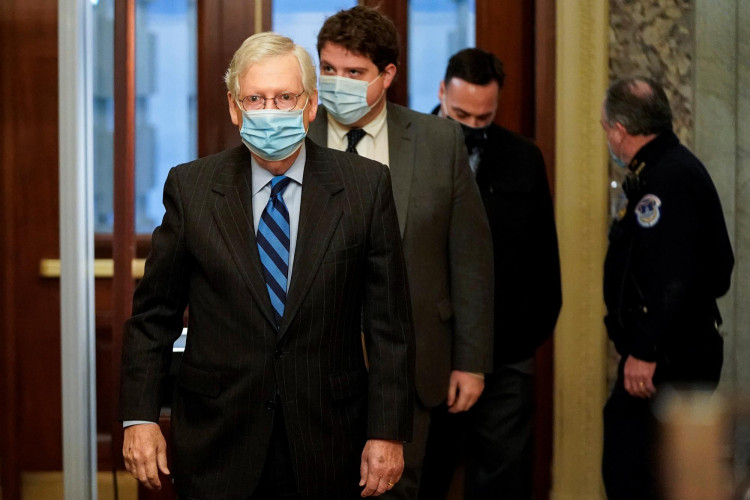
Sen. Mitch McConnell is aiming to return to Washington when the Senate reconvenes Sept. 14, according to Rep. James Comer, potentially ending a nearly three-month absence that began when the 84-year-old Kentucky Republican was hospitalized after a fall and later treated for pneumonia.
McConnell's office hasn't formally announced a return date, leaving some uncertainty over whether he will be back on Capitol Hill when lawmakers return from their summer recess. Comer, a Kentucky Republican, said Thursday that his expectation was based on conversations with members of McConnell's staff rather than with the senator himself.
"I have not talked to Leader McConnell," Comer told reporters. "I've talked to his staff, many of whom are from my district originally. And they have all said it's their goal for Senator McConnell to be here when the Senate comes in." Asked specifically whether he expected McConnell back Sept. 14, Comer said, "I expect that. I sure hope so."
A McConnell spokeswoman had told CNN a day earlier that there were "no scheduling announcements at this time," underscoring that the Sept. 14 target remains an expectation rather than a confirmed return date.
McConnell has been absent from the Capitol since June, when a fall at his home left him briefly unconscious and resulted in his hospitalization. His office initially provided few details about what had happened, fueling questions in Washington and Kentucky about the condition of one of the Senate's longest-serving members.
McConnell eventually addressed those questions in a July statement, saying extensive medical testing had ruled out several serious conditions.
"My doctors have confirmed that I didn't break any bones or suffer a concussion," McConnell said. "I didn't have a heart attack or a stroke. I don't have any tumors or hemorrhages. But I was briefly unconscious and was taken to the hospital. While receiving excellent care over the past several weeks, I've also had to deal with a mild case of pneumonia."
The Office of the Attending Physician said McConnell's mobility difficulties remained connected to the effects of childhood polio. McConnell has experienced several falls in recent years, and doctors prescribed an intensive physical-therapy program intended in part to reduce his future risk of falling.
After leaving hospital care, McConnell moved to a rehabilitation facility to regain strength. He was discharged from rehabilitation in early August and continued his recovery and physical therapy at home.
The prolonged absence has kept McConnell away from Senate floor votes since June. He has said, however, that he continued working with his legislative and Kentucky staffs and remained in contact with Senate colleagues while undergoing treatment.
"As much as it frustrates me, this process takes time," McConnell said in July. "And on the advice of my doctors, I won't be able to return to the Senate floor to vote quite yet."
The limited information initially released about McConnell's hospitalization also produced calls for greater transparency. Kentucky Gov. Andy Beshear was among those who publicly sought additional information about the senator's condition as his absence stretched into weeks.
McConnell acknowledged those concerns when he disclosed the circumstances of his hospitalization, describing a reluctance among people of his generation to discuss the vulnerabilities associated with aging. He nevertheless emphasized that he intended to complete the Senate term Kentucky voters elected him to serve.
"And part of my decision to retire at the end of my term this coming January was being honest about the demands of Senate work," McConnell said. "But I still have unfinished business to complete on your behalf, and I have every intention of finishing the job you elected me to do."
McConnell, a seven-term senator and former Senate majority leader, isn't seeking another term. His planned retirement will end a Senate career that began in 1985, making the remaining months of 2026 his final stretch in office.