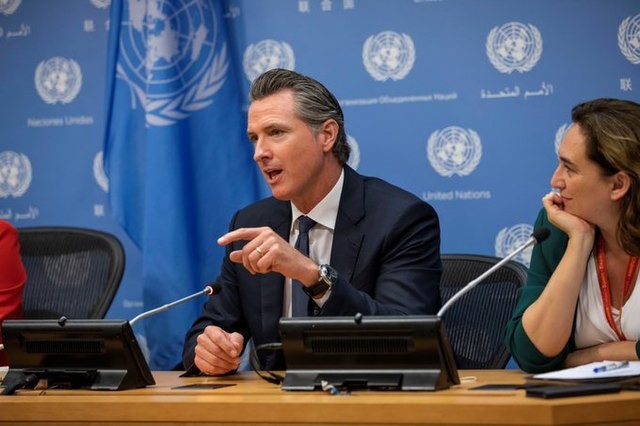
California Gov. Gavin Newsom accused President Donald Trump of trying to buy political support after Trump promised a $5,000 payment to American adults if Republicans retain control of Congress in November, escalating a fight over a proposal that could cost roughly $1.35 trillion and would require lawmakers to authorize the money.
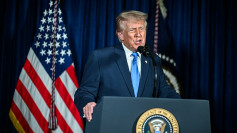
Trump announced what he called the "Trump Dividend" during a nearly two-hour address Wednesday at the Republican Party's midterm convention in Dallas. "If the Republicans win, you win with us and you get $5,000," Trump said. "It will be called the Trump Dividend." The Associated Press reported that the proposal would likely cost well above $1 trillion and require congressional approval.
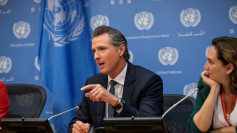
Newsom responded by connecting the pledge to both the November elections and Trump's handling of the war with Iran. "After making you sicker and poorer with his war, Trump now wants to buy your vote with $5,000 in taxpayer-funded blood money," Newsom said. He separately called Trump "the most corrupt man ever to occupy the Oval Office."
Those statements are political accusations, rather than findings that Trump's proposal constitutes bribery or an illegal payment for votes. The plan as described by Trump would make eligibility depend on Republican control of Congress, not on how an individual recipient voted, and Trump didn't say recipients would have to prove that they voted Republican.
Attorney John Day told the Associated Press that such a broadly available government payment wouldn't generally constitute buying an individual's vote if recipients could receive it regardless of whether they voted or whom they supported. The larger immediate legal obstacle is spending authority: Congress, rather than the president acting alone, generally controls federal appropriations.
Trump said every adult U.S. citizen would qualify and that recipients would have to spend the money inside the U.S. He didn't explain during the Dallas speech how that restriction would operate or identify legislation that would establish the payment program. ABC News also reported that Trump described the payout as similar to a cash distribution made by a successful corporation to shareholders.
The numbers make financing a central issue. Reuters reported an estimated cost of about $1.35 trillion if the payment were broadly distributed, while the Associated Press put the potential cost above $1 trillion. No comparable pool of money has been appropriated for such checks.
Vice President JD Vance suggested tariffs could provide at least part of the financing and indicated that wealthy Americans might ultimately be excluded from the program. He said Americans would "share in some of the benefit of this incredible wealth that we are creating."
Current tariff-revenue projections, however, are far smaller than the estimated cost of a one-time $5,000 payment to nearly every adult. The Tax Policy Center estimates that Trump administration tariffs currently in effect will raise about $1.7 trillion over the entire 2026-through-2036 budget window, including approximately $177 billion during fiscal 2026.
That distinction matters because the $1.7 trillion estimate represents projected collections spread across more than a decade, not cash currently available to distribute. A $1.35 trillion payout in a single round would amount to roughly 7.6 times the Tax Policy Center's estimated tariff revenue for 2026.
The federal government is also operating with a large existing budget deficit. The Associated Press reported an annual deficit approaching $1.8 trillion, meaning a new payment program would either need an identified source of revenue, offsetting spending reductions, or additional federal borrowing unless Congress designed it differently.
Trump has floated cash-dividend proposals before. He previously proposed a $2,000 tariff-funded dividend and discussed returning savings associated with government-efficiency efforts to taxpayers, but those proposals didn't develop into broad payment programs. MarketWatch reported that earlier tariff and "DOGE dividend" proposals never resulted in the promised nationwide checks.
The president has separately authorized a $1,776 payment to members of the military that he called a "warrior dividend," but that was a narrower initiative involving a defined group rather than a payment potentially reaching hundreds of millions of civilians.
Economist Peter Schiff criticized the new proposal as an effort to "buy the midterms" and described it as bribing Americans "in exchange for their votes." Schiff also argued that financing a large shortfall could ultimately fuel inflation if monetary policy were used to accommodate additional federal borrowing. His statements are economic and political assessments, not a description of a financing mechanism that the administration has formally proposed.
Trump tied the dividend directly to Republican success while also asking supporters to treat the congressional elections as a referendum on him. "So I'm asking you to pretend that I'm on the ballot. I'm on the ballot. I'm on the ballot," Trump told the Dallas audience.
The pledge arrives as household finances remain central to the political debate, with food, housing, transportation and healthcare costs occupying voters' attention. Trump has argued that his tariff, tax and economic policies are strengthening the country, while Democrats including Newsom have sought to connect higher living costs to administration policies and the continuing Iran conflict.