President Donald Trump promised a $5,000 "Trump dividend" to every adult U.S. citizen if Republicans retain control of the House and Senate in November, putting a potentially $1.35 trillion federal payout at the center of his party's midterm campaign while leaving unanswered how Congress would authorize or finance it.
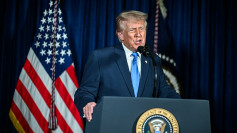
Trump unveiled the proposal Wednesday during a nearly two-hour prime-time address at the Republican Party's first midterm convention in Dallas. The president said the payment would resemble a corporate distribution to shareholders and would have to be spent inside the U.S.
"If the Republicans win, you win with us and you get $5,000," Trump said. "It will be called the Trump dividend, congratulations."
The proposal is a campaign pledge rather than an authorized federal program. Trump provided no detailed funding mechanism, eligibility rules or legislative framework, and the Associated Press reported that congressional approval would be required before the government could distribute the money.
The potential price tag is substantial. With roughly 270 million adults in the U.S., Reuters calculated that distributing $5,000 to each would cost approximately $1.35 trillion, an amount that would add significant pressure to federal finances if Congress didn't pair the program with sufficient new revenue or spending reductions.
Vice President JD Vance suggested after Trump's announcement that tariff revenue could help pay for the program and indicated that wealthy Americans might ultimately be excluded. Such restrictions would lower the total cost, but the administration hasn't released an income threshold or other eligibility criteria.
The pledge gives Trump a direct economic message as Republicans try to mobilize voters who supported him in the 2024 presidential election but may be less likely to participate when he isn't personally on the ballot. Trump explicitly encouraged supporters in Dallas to approach November's congressional contests as a referendum on his presidency.
"I'm asking you to pretend that I'm on the ballot," Trump said. Republicans face elections for control of both chambers on Nov. 3, and Trump said he plans to campaign extensively in competitive states and congressional districts during the final weeks.
The two-day convention has reinforced the extent to which the Republican midterm strategy is centered on Trump. Vice President Vance is scheduled to deliver Thursday's keynote before Trump returns for closing remarks, while Cabinet officials, congressional leaders and candidates in competitive races have used the Dallas stage to promote the administration's record.
Not every Republican facing a difficult election made the trip. Reuters reported that Sen. Susan Collins of Maine, Sen. Dan Sullivan of Alaska and Rep. Tom Barrett of Michigan were among candidates in competitive races who skipped the gathering. At least 16 candidates in competitive House and Senate contests were nevertheless scheduled to speak.
The convention also produced an unusual cross-party appearance from Democratic Sen. John Fetterman of Pennsylvania. In a prerecorded video, Fetterman introduced Republican Sen. Dave McCormick as his "great friend" and said he would work with Trump to protect Pennsylvania's steel industry. Fetterman has rejected speculation that he plans to leave the Democratic Party.
Other Republican speakers concentrated their attacks on Democrats' economic and social policies. Sen. Tim Scott of South Carolina, chairman of the National Republican Senatorial Committee, called Democrats "dangerous, radical and weird," while other speakers repeatedly used "socialists" and "communists" to characterize Democratic opponents. Those descriptions represent Republican campaign rhetoric rather than neutral classifications of the Democratic Party.
Trump also defended the continuing U.S. war with Iran, arguing that military action was necessary to prevent Tehran from obtaining a nuclear weapon. Iran says it isn't seeking nuclear weapons, while analysts cited by Reuters have said its nuclear program hasn't been eliminated despite months of U.S. and Israeli military operations.
The president linked the conflict to energy prices, telling the Dallas audience that oil prices would decline "as soon as we win the war with Iran" and predicting victory soon. The war has stretched beyond six months and contributed to economic uncertainty as disruptions around the Persian Gulf have affected global energy markets.
Trump's $5,000 proposal adds another fiscal question to the campaign. Reuters noted Thursday that the Treasury would likely have to borrow more than $1 trillion if Congress authorized a broadly distributed payment without sufficient offsetting revenue, while the AP reported that the federal government is already running an annual deficit of roughly $1.8 trillion.
Trump has previously floated cash distributions, including a $2,000 dividend tied to tariff revenue. The earlier proposal didn't become a nationwide payment program, making congressional action and a defined financing mechanism the critical steps between Wednesday's campaign promise and any $5,000 checks reaching American households.