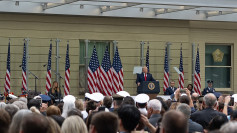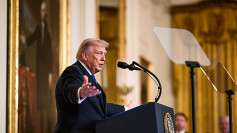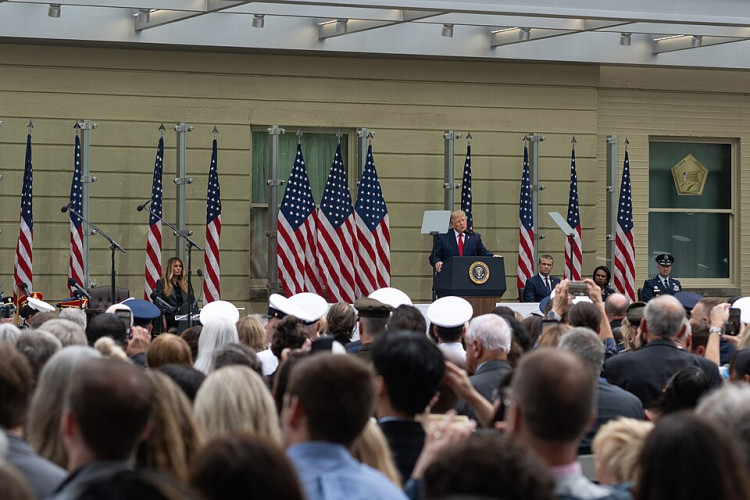
President Donald Trump's appearance at the Pentagon's 25th-anniversary commemoration of the Sept. 11 attacks renewed attention to his health Friday, after photographs appeared to show swelling around his ankles. Trump, 80, was diagnosed last year with chronic venous insufficiency, a condition that can cause swelling in the lower legs, though photographs from the ceremony alone can't establish whether his condition has changed.
Trump attended the Arlington, Va., ceremony with First Lady Melania Trump, honoring the 184 people killed when American Airlines Flight 77 struck the Pentagon on Sept. 11, 2001. Vice President JD Vance attended the Ground Zero commemoration in New York, where four former presidents joined victims' families to mark 25 years since attacks that killed 2,977 people.
There was no public indication that Trump suffered an acute medical problem during Friday's event, and the White House hadn't announced any deterioration in the vascular condition previously disclosed by his physician. The images nevertheless revived discussion of an issue that has periodically attracted attention because of visible swelling in Trump's lower legs.
The White House first disclosed the diagnosis in July 2025 after Trump reported swelling and underwent a medical evaluation, including bilateral lower-extremity venous Doppler ultrasounds. Navy Capt. Sean Barbabella, physician to the president, said the examination revealed chronic venous insufficiency, which he described as a "benign and common condition, particularly in individuals over the age of 70."
The testing found no evidence of deep-vein thrombosis or arterial disease, according to the White House. Reuters reported at the time that the evaluation also found no evidence of heart failure or kidney impairment that would explain the swelling.
Chronic venous insufficiency develops when veins in the legs have difficulty moving blood back toward the heart efficiently, allowing blood to pool in the lower extremities. Swelling around the ankles and legs is among its possible symptoms, meaning an assessment of severity or progression requires medical examination rather than interpretation of photographs.
Trump's latest publicly released physical provides another reference point. Following an examination at Walter Reed National Military Medical Center in May, Barbabella said Trump remained in "excellent physical health" and was fully fit to perform the duties of the presidency. The report said his lower-leg swelling had improved from the previous year.
The Wall Street Journal reported earlier this year that Trump had briefly tried compression socks, a commonly used measure for chronic venous insufficiency, but stopped because he disliked wearing them. The Journal also reported that Trump sought to avoid remaining seated for extended periods.
The White House has consistently pushed back against broader speculation about Trump's health. Administration officials and Trump himself have emphasized his schedule and public appearances, while his physician's reports have characterized him as capable of carrying out his responsibilities. Trump similarly dismissed health speculation circulating on social media in September 2025 as "fake," telling reporters, "I was very active over the weekend."
Friday's ceremony placed that renewed health discussion against a much larger commemoration. At the Pentagon, Trump recounted stories of people killed aboard Flight 77, including a pregnant woman, a family traveling to Australia and three sixth-graders on a school trip.
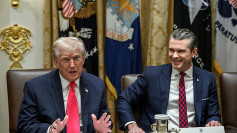
Trump and Defense Secretary Pete Hegseth also invoked the administration's continuing military campaign against Iran during their remarks. "We salute our first responders and law enforcement, and we love them," Trump said. "And we salute the service members working right now to ensure the world's number one sponsor of terror, the Islamic Republic of Iran, will never ever have a nuclear weapon."
The Pentagon observance was one of several ceremonies across the country marking a quarter-century since the attacks. At Ground Zero, organizers added a seventh moment of silence for the first time to recognize people who have subsequently died from illnesses associated with exposure to toxic dust after the World Trade Center collapsed. More than 600 firefighters, including retired members who participated in rescue and recovery work, have died from 9/11-related illnesses, according to New York City Fire Department figures reported by Reuters.
Trump left Washington after the commemoration for a 48-hour trip to Ireland that included meetings with Irish President Catherine Connolly and Taoiseach Micheál Martin before a visit to his golf resort in Doonbeg, County Clare. The trip also generated political attention after Trump said he would "love" to see the Republic of Ireland and Northern Ireland unified.
"Well, I don't want to cause any problems, but I will tell you, I'd love to see it unified. It's going to happen eventually," Trump told reporters while sitting alongside Martin. His remarks drew objections from unionist politicians in Northern Ireland, while the British government reiterated that its position on a possible referendum hadn't changed.