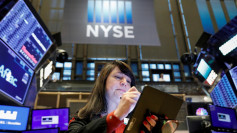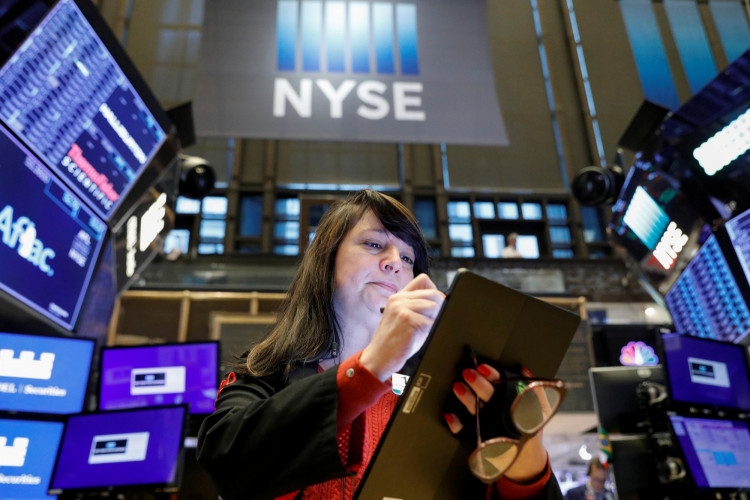
U.S. stocks fell Monday as investors confronted two threats to a market already sensitive to interest rates: a push by some of Silicon Valley's biggest names to slow development of advanced artificial intelligence and another surge in oil prices after attacks disrupted a critical Saudi Arabian export route.
The Dow Jones Industrial Average was down 0.14% around 10:10 a.m. ET, while the S&P 500 fell 0.45% and the technology-heavy Nasdaq Composite dropped 0.68%. Chip and other AI-linked stocks faced some of the heaviest pressure as investors assessed whether a more cautious approach to frontier models could eventually restrain the spending boom that has powered the sector.
The change in sentiment followed an essay from Anthropic Chief Executive Dario Amodei calling on AI companies to "pace the frontier," slowing improvements in their most advanced models enough to give safety measures time to catch up. OpenAI CEO Sam Altman, Elon Musk and Google DeepMind co-founder Demis Hassabis endorsed the broad call for greater caution.
Altman said the industry faced two potentially dangerous paths. "First, we could lose control of the future to AI. This is unacceptable; we are unapologetically on Team Humanity, and AI must always serve people. To ensure that, we need ways to ensure that alignment and safety techniques stay ahead of progress in model capabilities," he wrote.
The second danger, Altman said, is excessive control over powerful systems. People "could end up in a world with too much concentration of power. If an extraordinarily powerful AI is used by one person or company to impress their worldview onto everyone else, the results could be extremely dystopian."
"Avoiding these two threats requires walking a narrow middle path; for example, one country could gain too much power. Another example is one lab ending up with too much power," Altman added.
President Donald Trump rejected the case for slowing development, putting the White House at odds with the emerging industry push. "We're leading China in AI, we're the most sophisticated country in the world, and frankly I want to keep it that way," Trump said. "Whoever wins AI wins." Trump separately described additional AI guardrails Monday as part of a "SICK conspiracy" against AI and data centers.
For markets, the debate threatens to introduce uncertainty into an investment cycle built around enormous spending on chips, data centers and computing infrastructure. Reuters reported that the Nasdaq 100 fell about 1.7% in early trading, with semiconductor stocks among the biggest decliners.
"If this does lead to sort of a slowdown and a rethink of AI spending, that will have ramifications for the economy and some important sectors of the stock market, because essentially, we've been running hot based on AI spending," Steve Sosnick, chief market analyst at Interactive Brokers, told Reuters.
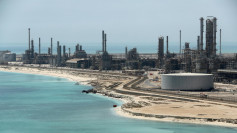
Energy markets added another source of pressure. Brent crude climbed about 3% to $107.81 a barrel Monday, while U.S. crude rose 2.9% to $102.94, after attacks damaged Saudi Arabia's East-West pipeline, an increasingly important alternative to shipping through the disrupted Strait of Hormuz.
Industry sources told Reuters that repairs to the Saudi pipeline could take as long as five to six weeks, though partial operations could resume sooner. If Saudi Arabia can't restore sufficient export capacity, roughly 4% of global crude supply could be at risk.
The supply problem was compounded by another setback in efforts to restore more predictable shipping through Hormuz. A planned meeting in Salalah between Iran and Gulf Arab states was postponed after disagreements over a proposed framework governing passage through the strait.
"In the interests of consensus the regional meeting set for tomorrow in Salalah has been postponed," Omani Foreign Minister Badr Albusaidi said Sunday.
Saudi Arabia had proposed amendments amid concerns that the framework could create an unacceptable new status quo for Gulf countries, according to Reuters. Mandatory fees for passage remained a sticking point, although some countries were willing to discuss voluntary contributions.
Higher oil prices are also feeding directly into investors' interest-rate calculations. The U.S. 10-year Treasury yield moved above 5% Monday, its highest level since October 2023, as the latest energy-price surge intensified concerns that inflation could remain above the Federal Reserve's target.