Brett Wattles

The Latest
-
NASA Confirms 3I/ATLAS Is a Natural Interstellar Comet, Ending Alien Spacecraft Claims
NASA has formally concluded that 3I/ATLAS, the third confirmed interstellar object ever detected passing through the solar system, is a naturally occurring comet, bringing months of speculation about extraterrestrial technology to a close as the object continues its outbound journey into deep space. 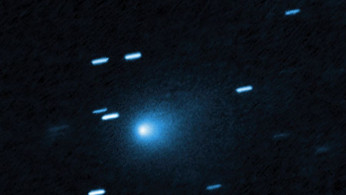
NASA has formally concluded that 3I/ATLAS, the third confirmed interstellar object ever detected passing through the solar system, is a naturally occurring comet, bringing months of speculation about extraterrestrial technology to a close as the object continues its outbound journey into deep space. -
Scientists Reassess Interstellar Object 3I/ATLAS After Unusual Geometry and Extreme Speeds Detected
Scientists are reexamining long-held assumptions about interstellar objects after new observations of 3I/ATLAS, only the third confirmed visitor from beyond the solar system, revealed geometric features and motion patterns that do not fit neatly within existing comet or asteroid models. 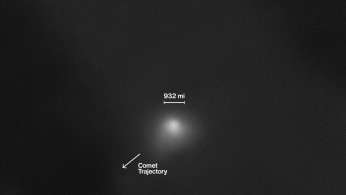
Scientists are reexamining long-held assumptions about interstellar objects after new observations of 3I/ATLAS, only the third confirmed visitor from beyond the solar system, revealed geometric features and motion patterns that do not fit neatly within existing comet or asteroid models. -
NASA’s Europa Clipper Unlocks New Clues on Interstellar Comet 3I/ATLAS as Radio Signal Search Comes Up Empty
NASA scientists have confirmed new details about the interstellar comet known as 3I/ATLAS after capturing rare ultraviolet observations from the Europa Clipper spacecraft, even as a parallel search for artificial radio signals ended without detection. The findings deepen scientific understanding of the fastest interstellar object ever observed while closing the door-at least for now-on speculation about non-natural origins. 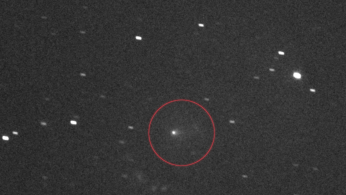
NASA scientists have confirmed new details about the interstellar comet known as 3I/ATLAS after capturing rare ultraviolet observations from the Europa Clipper spacecraft, even as a parallel search for artificial radio signals ended without detection. The findings deepen scientific understanding of the fastest interstellar object ever observed while closing the door-at least for now-on speculation about non-natural origins. -
NASA Reveals Green Glow of Interstellar Comet 3I/ATLAS as It Exits Solar System
Astronomers at NASA and the Gemini North Observatory have released new images of 3I/ATLAS, revealing a vivid green glow that underscores the object's alien origins and fleeting passage through the Solar System. The comet, only the third confirmed interstellar visitor ever detected, is now providing scientists with rare visual and chemical clues about material formed around a distant, unknown star. Astronomers at NASA and the Gemini North Observatory have released new images of 3I/ATLAS, revealing a vivid green glow that underscores the object's alien origins and fleeting passage through the Solar System. The comet, only the third confirmed interstellar visitor ever detected, is now providing scientists with rare visual and chemical clues about material formed around a distant, unknown star. -
Interstellar Object 3I/ATLAS Fuels Debate Over Origins as Scientists Test Claims of Extreme Age
An interstellar object detected last summer has ignited a renewed debate among astronomers after researchers floated the possibility that it may have formed near the dawn of the Milky Way, challenging assumptions about how ancient material can survive intact in interstellar space. The object, designated 3I/ATLAS, was first observed on July 1, 2025, by the Asteroid Terrestrial-impact Last Alert System operating from Chile. An interstellar object detected last summer has ignited a renewed debate among astronomers after researchers floated the possibility that it may have formed near the dawn of the Milky Way, challenging assumptions about how ancient material can survive intact in interstellar space. The object, designated 3I/ATLAS, was first observed on July 1, 2025, by the Asteroid Terrestrial-impact Last Alert System operating from Chile. -
Interstellar Object 3I/ATLAS Triggers New Security Scrutiny After Late Detection Near Earth
A faint interstellar object detected in July 2025 has quietly reshaped how scientists and security planners view threats from deep space, after analysts concluded it passed hundreds of millions of miles from Earth before being identified. Known as 3I/ATLAS, the object is only the third confirmed visitor from outside the solar system and is now being examined not only as a scientific anomaly but as a test of planetary defense readiness. A faint interstellar object detected in July 2025 has quietly reshaped how scientists and security planners view threats from deep space, after analysts concluded it passed hundreds of millions of miles from Earth before being identified. Known as 3I/ATLAS, the object is only the third confirmed visitor from outside the solar system and is now being examined not only as a scientific anomaly but as a test of planetary defense readiness. -
Interstellar Comet 3I/ATLAS Dumps 13.5 Million Tons of Water as Scientists Decode Its Origins
Astronomers tracking 3I/ATLAS, the third confirmed interstellar object ever observed, say new measurements of its water loss and chemical makeup are offering one of the clearest looks yet at material formed around another star, even as searches for artificial signals from the object come up empty. Astronomers tracking 3I/ATLAS, the third confirmed interstellar object ever observed, say new measurements of its water loss and chemical makeup are offering one of the clearest looks yet at material formed around another star, even as searches for artificial signals from the object come up empty. -
Interstellar Object 3I/ATLAS Sparks Debate as Scientist Says Its Behavior Defies Known Comet Physics
The discovery of the interstellar object known as 3I/ATLAS has reignited debate among astronomers after new observations suggested behavior that some researchers say cannot be easily explained by conventional comet physics. First detected on July 1, 2025, by the NASA-funded Asteroid Terrestrial-impact Last Alert System in Chile, the object is only the third confirmed visitor from outside the solar system, following 1I/'Oumuamua and 2I/Borisov. The discovery of the interstellar object known as 3I/ATLAS has reignited debate among astronomers after new observations suggested behavior that some researchers say cannot be easily explained by conventional comet physics. First detected on July 1, 2025, by the NASA-funded Asteroid Terrestrial-impact Last Alert System in Chile, the object is only the third confirmed visitor from outside the solar system, following 1I/'Oumuamua and 2I/Borisov. -
Interstellar Object 3I/ATLAS Traced to Milky Way’s Core, Raising New Questions About Its Extreme Origins
Astronomers analyzing the interstellar object known as 3I/ATLAS say new trajectory and composition data point to an origin deep within the Milky Way's central region, an environment marked by intense radiation, dense stellar traffic and extreme gravitational forces. The object, discovered on July 1, 2025, by the ATLAS survey in Río Hurtado, Chile, is now understood to have entered the solar system from the direction of the Sagittarius constellation, a corridor that aligns with the galaxy's turbulent core roughly 26,000 light-years away. Astronomers analyzing the interstellar object known as 3I/ATLAS say new trajectory and composition data point to an origin deep within the Milky Way's central region, an environment marked by intense radiation, dense stellar traffic and extreme gravitational forces. The object, discovered on July 1, 2025, by the ATLAS survey in Río Hurtado, Chile, is now understood to have entered the solar system from the direction of the Sagittarius constellation, a corridor that aligns with the galaxy's turbulent core roughly 26,000 light-years away. -
Hubble Spots Dual Jets on 3I/ATLAS as Avi Loeb Flags ‘Controlled’ Pattern in Fast-Moving Interstellar Object
Fresh observations from the Hubble Space Telescope have intensified debate over the nature of 3I/ATLAS, a fast-moving interstellar object whose unusual jet behavior has drawn scrutiny from astronomers including Harvard astrophysicist Avi Loeb. Images captured in mid- and late December show a stable, dual-jet structure that appears to operate in a coordinated, rhythmic pattern, raising questions about whether the object behaves like a conventional comet or something more complex. Fresh observations from the Hubble Space Telescope have intensified debate over the nature of 3I/ATLAS, a fast-moving interstellar object whose unusual jet behavior has drawn scrutiny from astronomers including Harvard astrophysicist Avi Loeb. Images captured in mid- and late December show a stable, dual-jet structure that appears to operate in a coordinated, rhythmic pattern, raising questions about whether the object behaves like a conventional comet or something more complex.
