Brett Wattles

The Latest
-
Interstellar Comet 3I/ATLAS Makes Closest-Ever Pass, Offering Rare Clues to Alien Planet Formation
Astronomers are preparing for a rare observational opportunity as interstellar comet 3I/ATLAS approaches its closest point to Earth on Dec. 19, marking the nearest encounter humanity will ever have with the object. The visitor, which originated outside the solar system, is only the third confirmed interstellar body ever detected passing through Earth's neighborhood, offering scientists an unusually clear look at material formed around another star. 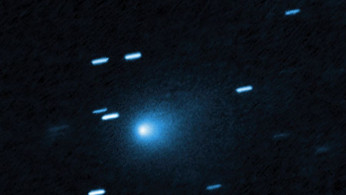
Astronomers are preparing for a rare observational opportunity as interstellar comet 3I/ATLAS approaches its closest point to Earth on Dec. 19, marking the nearest encounter humanity will ever have with the object. The visitor, which originated outside the solar system, is only the third confirmed interstellar body ever detected passing through Earth's neighborhood, offering scientists an unusually clear look at material formed around another star. -
Interstellar Object 3I/ATLAS Exposes Gaps in Planetary Defense as Detection Timelines Shrink
The passage of the interstellar object known as 3I/ATLAS through the inner solar system is prompting scientists and planetary-defense officials to reassess long-standing assumptions about how Earth identifies and prepares for potential cosmic threats. While the object itself poses no danger-its closest approach on Dec. 19 will occur at a distance of roughly 270 million kilometers-the circumstances of its arrival are underscoring vulnerabilities in existing detection and response frameworks. The passage of the interstellar object known as 3I/ATLAS through the inner solar system is prompting scientists and planetary-defense officials to reassess long-standing assumptions about how Earth identifies and prepares for potential cosmic threats. While the object itself poses no danger-its closest approach on Dec. 19 will occur at a distance of roughly 270 million kilometers-the circumstances of its arrival are underscoring vulnerabilities in existing detection and response frameworks. -
Interstellar Comet 3I/ATLAS Defies Expectations as Sun-Facing Anti-Tail Shifts Near Earth Approach
Astronomers monitoring the interstellar object known as 3I/ATLAS say new observations show an unexpected shift in the orientation of its rare "anti-tail" as the object approaches its closest point to Earth, adding fresh complexity to the scientific effort to understand material formed beyond the solar system. The change has been confirmed by multiple observatories and has become a focal point for debate over how dust and radiation interact in interstellar comets. 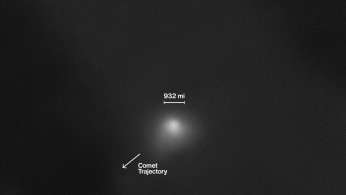
Astronomers monitoring the interstellar object known as 3I/ATLAS say new observations show an unexpected shift in the orientation of its rare "anti-tail" as the object approaches its closest point to Earth, adding fresh complexity to the scientific effort to understand material formed beyond the solar system. The change has been confirmed by multiple observatories and has become a focal point for debate over how dust and radiation interact in interstellar comets. -
Interstellar Comet 3I/ATLAS Turns Green Ahead of Dec. 19 Earth Flyby, Offering Rare Chemical Clues
Astronomers tracking the interstellar comet known as 3I/ATLAS report that the object has brightened markedly and developed a faint green glow as it approaches its closest pass by Earth, sharpening scientific interest in only the third confirmed visitor from beyond the solar system. The color shift, documented in late November observations, is being closely analyzed as a potential indicator of the comet's chemical makeup and thermal evolution as it responds to increasing solar heat. 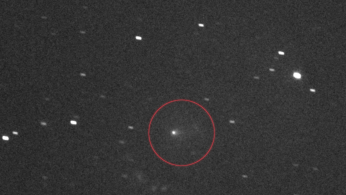
Astronomers tracking the interstellar comet known as 3I/ATLAS report that the object has brightened markedly and developed a faint green glow as it approaches its closest pass by Earth, sharpening scientific interest in only the third confirmed visitor from beyond the solar system. The color shift, documented in late November observations, is being closely analyzed as a potential indicator of the comet's chemical makeup and thermal evolution as it responds to increasing solar heat. -
As 3I/ATLAS Passes Earth, Astronomers Detect Low Water and High Carbon Dioxide Signature
An interstellar comet racing through the inner solar system is giving scientists a rare chemical snapshot of material formed around another star, with early findings showing an unexpectedly low water content and a high concentration of carbon dioxide. The object, known as 3I/ATLAS, is only the third confirmed interstellar visitor ever detected and is now approaching its closest point to Earth before continuing on a one-way exit from the solar system. An interstellar comet racing through the inner solar system is giving scientists a rare chemical snapshot of material formed around another star, with early findings showing an unexpectedly low water content and a high concentration of carbon dioxide. The object, known as 3I/ATLAS, is only the third confirmed interstellar visitor ever detected and is now approaching its closest point to Earth before continuing on a one-way exit from the solar system. -
Online Claims of Secret U.S. Tracking of Interstellar Comet 3I/ATLAS Collide With Scientific Record
The arrival of interstellar comet 3I/ATLAS in the inner Solar System in late 2025 sparked a burst of scientific observation-and a parallel surge of online claims that U.S. authorities had quietly tracked the object for decades through a classified planetary defense program known as CASSANDRA. No U.S. agency has confirmed the existence of such a program or any prior monitoring of the comet, and scientists say the evidence cited online does not withstand scrutiny. The arrival of interstellar comet 3I/ATLAS in the inner Solar System in late 2025 sparked a burst of scientific observation-and a parallel surge of online claims that U.S. authorities had quietly tracked the object for decades through a classified planetary defense program known as CASSANDRA. No U.S. agency has confirmed the existence of such a program or any prior monitoring of the comet, and scientists say the evidence cited online does not withstand scrutiny. -
FDA Weighs Black-Box Warning on Covid Vaccines, Sparking Pushback From Scientists - Report
The U.S. Food and Drug Administration is preparing to place its most serious safety warning on Covid-19 vaccines, a move that has stunned outside scientists and reignited political and scientific battles over a cornerstone of the pandemic response, according to people familiar with the agency's plans. The warning, known as a boxed or "black box" label, would represent the strongest caution the FDA can impose and would mark a sharp reversal in how the federal government publicly frames the vaccines' risk-benefit profile. 
The U.S. Food and Drug Administration is preparing to place its most serious safety warning on Covid-19 vaccines, a move that has stunned outside scientists and reignited political and scientific battles over a cornerstone of the pandemic response, according to people familiar with the agency's plans. The warning, known as a boxed or "black box" label, would represent the strongest caution the FDA can impose and would mark a sharp reversal in how the federal government publicly frames the vaccines' risk-benefit profile. -
Interstellar Comet 3I/ATLAS Stuns Scientists With 250,000-Mile X-Ray Halo
Astronomers studying the interstellar comet known as 3I/ATLAS have detected a vast and unexpected X-ray halo extending roughly 250,000 miles around the object, a finding that is challenging long-standing assumptions about comet behavior and the interaction between solar wind and material formed beyond the Solar System. The observation was made by the X-Ray Imaging and Spectroscopy Mission, or XRISM, a joint project led by Japan's space agency JAXA with participation from NASA and the European Space Agency. Astronomers studying the interstellar comet known as 3I/ATLAS have detected a vast and unexpected X-ray halo extending roughly 250,000 miles around the object, a finding that is challenging long-standing assumptions about comet behavior and the interaction between solar wind and material formed beyond the Solar System. The observation was made by the X-Ray Imaging and Spectroscopy Mission, or XRISM, a joint project led by Japan's space agency JAXA with participation from NASA and the European Space Agency. -
Interstellar Comet 3I/ATLAS Reveals Record Organic Enrichment, Hinting Life’s Building Blocks Are Universal
Interstellar comet 3I/ATLAS is reshaping scientists' understanding of how life-forming chemistry may arise beyond the Solar System, as new observations from U.S., European and Japanese missions reveal unusually enriched organic molecules and X-ray emissions never before detected from an alien object. The comet, discovered in July 2025 by NASA's ATLAS survey in Chile, is only the third confirmed visitor from another star system and is passing through the inner Solar System on a one-time trajectory before it disappears back into interstellar space. Interstellar comet 3I/ATLAS is reshaping scientists' understanding of how life-forming chemistry may arise beyond the Solar System, as new observations from U.S., European and Japanese missions reveal unusually enriched organic molecules and X-ray emissions never before detected from an alien object. The comet, discovered in July 2025 by NASA's ATLAS survey in Chile, is only the third confirmed visitor from another star system and is passing through the inner Solar System on a one-time trajectory before it disappears back into interstellar space. -
Harvard’s Avi Loeb Blasts '$90 Million Bias' in Astronomy, Says Oumuamua May Be Alien Technology
Harvard astrophysicist Avi Loeb renewed his criticism of the scientific establishment this week, accusing leading astronomy institutions of fostering an "irrational" and "anti-intellectual" bias against research that considers technological explanations for interstellar objects. The former Chair of Astronomy at Harvard University argues that conventional researchers have ignored compelling evidence about 1I/'Oumuamua-an object that entered the solar system from another star in 2017-and are dismissing the possibility that it may represent alien technology. 
Harvard astrophysicist Avi Loeb renewed his criticism of the scientific establishment this week, accusing leading astronomy institutions of fostering an "irrational" and "anti-intellectual" bias against research that considers technological explanations for interstellar objects. The former Chair of Astronomy at Harvard University argues that conventional researchers have ignored compelling evidence about 1I/'Oumuamua-an object that entered the solar system from another star in 2017-and are dismissing the possibility that it may represent alien technology.
