Brett Wattles

The Latest
-
Interstellar Object 3I/ATLAS Passes Earth Quietly, Undercutting Speculation and Online Theories
When the interstellar object known as 3I/ATLAS passed Earth on Dec. 19, 2025, astronomers around the world trained their instruments on a rare visitor from beyond the solar system. The encounter, closely tracked by NASA and major observatories, unfolded without incident, disappointing online speculation but delivering what scientists consider a valuable, if unspectacular, scientific data set. 
When the interstellar object known as 3I/ATLAS passed Earth on Dec. 19, 2025, astronomers around the world trained their instruments on a rare visitor from beyond the solar system. The encounter, closely tracked by NASA and major observatories, unfolded without incident, disappointing online speculation but delivering what scientists consider a valuable, if unspectacular, scientific data set. -
Interstellar Comet 3I/ATLAS Near Jupiter Could Test Physics Models in 2026, Loeb Says
Scientists are turning their attention to a rare interstellar encounter expected in March 2026, when comet 3I/ATLAS is projected to pass deep into the gravitational influence of Jupiter, an event some researchers say could offer an unusual test of long-standing assumptions in physics. 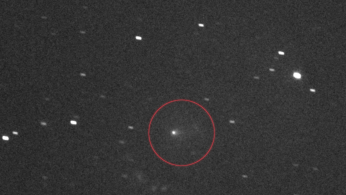
Scientists are turning their attention to a rare interstellar encounter expected in March 2026, when comet 3I/ATLAS is projected to pass deep into the gravitational influence of Jupiter, an event some researchers say could offer an unusual test of long-standing assumptions in physics. -
Interstellar Comet 3I/ATLAS Makes Closest Earth Pass at 168 Million Miles, Offering Rare Glimpse Into Milky Way’s Earliest Era
An interstellar comet believed to be billions of years older than the Sun passed its closest point to Earth on Friday, giving astronomers a fleeting opportunity to study what may be the oldest physical object ever detected in the solar system. An interstellar comet believed to be billions of years older than the Sun passed its closest point to Earth on Friday, giving astronomers a fleeting opportunity to study what may be the oldest physical object ever detected in the solar system. -
3I/ATLAS Reveals Unusual Chemistry at 150,000 mph, Offering New Clues to Alien Star Systems
Astronomers studying the interstellar object known as 3I/ATLAS say new observations from the Gemini North Telescope in Hawaii have revealed a striking chemical transformation as the comet exits the inner solar system, underscoring how little is known about material formed around distant stars. The object, first detected by NASA's Asteroid Terrestrial-impact Last Alert System on July 1, 2025, is only the third confirmed visitor from outside the solar system, following 1I/'Oumuamua in 2017 and 2I/Borisov in 2019. 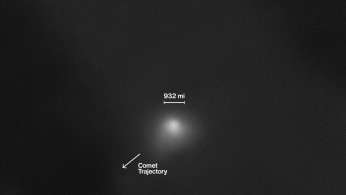
Astronomers studying the interstellar object known as 3I/ATLAS say new observations from the Gemini North Telescope in Hawaii have revealed a striking chemical transformation as the comet exits the inner solar system, underscoring how little is known about material formed around distant stars. The object, first detected by NASA's Asteroid Terrestrial-impact Last Alert System on July 1, 2025, is only the third confirmed visitor from outside the solar system, following 1I/'Oumuamua in 2017 and 2I/Borisov in 2019. -
NASA Data Clarifies Interstellar Object 3I/ATLAS as It Passes 170 Million Miles From Earth
NASA is tracking a rare interstellar object known as 3I/ATLAS as it approaches its closest point to Earth on Friday, offering scientists a fleeting opportunity to study material formed around another star system while tamping down online speculation about its origins. The object, discovered earlier this year by a Chile-based telescope in a NASA-funded survey network, will pass safely at a distance of about 170 million miles, according to agency data. NASA is tracking a rare interstellar object known as 3I/ATLAS as it approaches its closest point to Earth on Friday, offering scientists a fleeting opportunity to study material formed around another star system while tamping down online speculation about its origins. The object, discovered earlier this year by a Chile-based telescope in a NASA-funded survey network, will pass safely at a distance of about 170 million miles, according to agency data. -
California Issues Egg Recall After 63 Salmonella Cases, 13 Hospitalizations Linked to Single Farm
California health officials have urged consumers and food-service operators across Northern California to immediately inspect egg cartons following a Salmonella outbreak that has sickened at least 63 people and sent 13 to hospitals, according to state agencies overseeing the investigation. The illnesses have been traced to brown, in-shell eggs produced by Vega Farms and distributed widely through retail and commercial channels. 
California health officials have urged consumers and food-service operators across Northern California to immediately inspect egg cartons following a Salmonella outbreak that has sickened at least 63 people and sent 13 to hospitals, according to state agencies overseeing the investigation. The illnesses have been traced to brown, in-shell eggs produced by Vega Farms and distributed widely through retail and commercial channels. -
WHO Flags Rapid Spread of New H3N2 Flu Variant J.2.4.1 as Hospitalizations Rise in 30+ Countries
The World Health Organization is warning that a newly emerging influenza variant is spreading rapidly across multiple regions, prompting heightened surveillance as the global flu season intensifies and hospitalizations rise in several countries. The strain, an H3N2 subclade formally classified as J.2.4.1, has been detected in more than 30 countries since first appearing in the Southern Hemisphere late this summer. 
The World Health Organization is warning that a newly emerging influenza variant is spreading rapidly across multiple regions, prompting heightened surveillance as the global flu season intensifies and hospitalizations rise in several countries. The strain, an H3N2 subclade formally classified as J.2.4.1, has been detected in more than 30 countries since first appearing in the Southern Hemisphere late this summer. -
Interstellar Comet 3I/ATLAS Races Past Earth at 137,000 mph, Exposing Gaps in Planetary Defense
An interstellar object moving at roughly 137,000 miles an hour is making its closest approach to Earth this week, drawing intense scrutiny from astronomers and planetary-defense officials despite posing no direct threat. Known as 3I/ATLAS, the comet is only the third confirmed visitor from beyond the solar system and is traveling on a hyperbolic trajectory that has sharpened concerns about how quickly such objects can be detected and tracked. An interstellar object moving at roughly 137,000 miles an hour is making its closest approach to Earth this week, drawing intense scrutiny from astronomers and planetary-defense officials despite posing no direct threat. Known as 3I/ATLAS, the comet is only the third confirmed visitor from beyond the solar system and is traveling on a hyperbolic trajectory that has sharpened concerns about how quickly such objects can be detected and tracked. -
FDA Recalls 3,556 Cases of Salad Dressing Across 27 States Over Plastic Contamination Risk
U.S. regulators have ordered a sweeping recall of salad dressings distributed across 27 states after identifying possible contamination with black plastic planting material, a move that has prompted warnings to consumers and food-service operators amid concerns over injury and choking hazards. 
U.S. regulators have ordered a sweeping recall of salad dressings distributed across 27 states after identifying possible contamination with black plastic planting material, a move that has prompted warnings to consumers and food-service operators amid concerns over injury and choking hazards. -
Interstellar Comet 3I/ATLAS Displays 500,000-Kilometer Sunward Anti-Tail, Defying Standard Models
Astronomers are intensifying scrutiny of interstellar object 3I/ATLAS after images captured this week revealed a massive, sunward-facing anti-tail extending roughly half a million kilometers-longer than the average distance between Earth and the Moon-an observation that challenges conventional comet physics as the object approaches its closest pass by Earth. Astronomers are intensifying scrutiny of interstellar object 3I/ATLAS after images captured this week revealed a massive, sunward-facing anti-tail extending roughly half a million kilometers-longer than the average distance between Earth and the Moon-an observation that challenges conventional comet physics as the object approaches its closest pass by Earth.
